Hanzi Writer

How to Write 譬 (pì) — Meaning “Metaphor; Example”

HSK Level 7 20 strokes Radical: 言

譬 (pì) means "Metaphor; Example" in Chinese. It has 20 strokes with the radical 言, and is HSK Level 7.

Rated 4.2/5 in difficulty (advanced).

Harder than 90% of HSK Level 7 characters.

Appears in 3+ common words including 譬如 (pì rú), 譬喻 (pì yù), 比譬 (bǐ pì).

Due to its 20 strokes, Hanzi Writer's error detection shows 譬 requires focused practice — most learners need 10+ attempts for consistent accuracy.
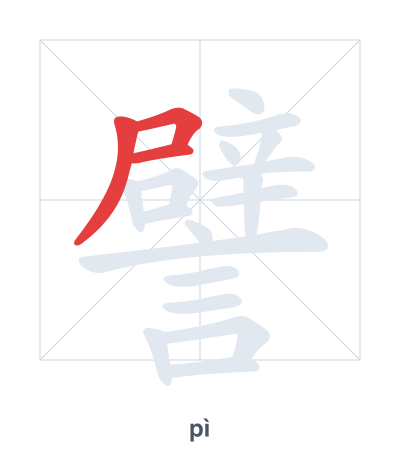
Stroke order practice for 譬 - pì

Practice Writing 譬 (pì)

Open Hanzi Writer to see the animated stroke order and practice writing 譬 with real-time feedback.

The character (pì) is written with 20 strokes. Follow the standard Chinese stroke order: top to bottom, left to right, outside before inside. The radical is one of its key components.

Practice the correct stroke order with the Hanzi Writer app to see animated stroke-by-stroke guidance with real-time feedback.

means Metaphor; Example.

As an HSK Level 7 character, is an intermediate-level character.

Character
Pinyinpì (pi)
MeaningMetaphor; Example
Strokes20
Radical
HSK Level7
Difficulty4.2/5

譬 combines 言 (speech) with 辟, which provides the sound and suggests 'opening up' or 'illustrating'. Thus, the character depicts using words to open up a comparison, making a metaphor or giving an example.

💡 Memory Tip: Imagine a corpse (尸) using its mouth (口) to speak (言) a spicy (辛) metaphor as an example.

pì rú
For example; Such as
pì yù
Metaphor; Analogy
bǐ pì
Metaphor / Parable

譬如,你可以坐地铁去。

pì rú nǐ kě yǐ zuò dì tiě qù

For example, you can go by subway.

这个譬喻非常生动。

zhè ge pì yù fēi cháng shēng dòng

This metaphor is very vivid.

他用这个故事作比譬。

tā yòng zhè ge gù shì zuò bǐ pì

He used this story as an analogy.

Character Pinyin Strokes Radical
(current) 20
luán 19
qǐng 18
jǐng 19
Stroke order practice for 譬 - pì

Practice Writing 譬 (pì)

Open Hanzi Writer to see the animated stroke order and practice writing 譬 with real-time feedback.

✨ Animated stroke order · Handwriting recognition · HSK-graded practice · Free to use

Frequently Asked Questions about 譬

譬 is composed of two parts: the top part 辟 (pì, meaning "to open up" or "to compare") and the bottom radical 言 (speech/words). Together, they suggest using words to open up an idea through comparison — a metaphor or example. The radical 言 shows that this action is done through speaking or writing.

More HSK Level 7 Characters

Characters with Radical 言

Other 20-Stroke Characters