訇 (hōng) means "loud crash / bang" in Chinese. It has 9 strokes with the radical 言.
Rated 4/5 in difficulty (challenging).
Appears in 3+ common words including 阿訇 (ā hōng), 訇然 (hōng rán), 訇訇 (hōng hōng).
Due to its 9 strokes, Hanzi Writer's error detection shows 訇 requires focused practice — most learners need 10+ attempts for consistent accuracy.
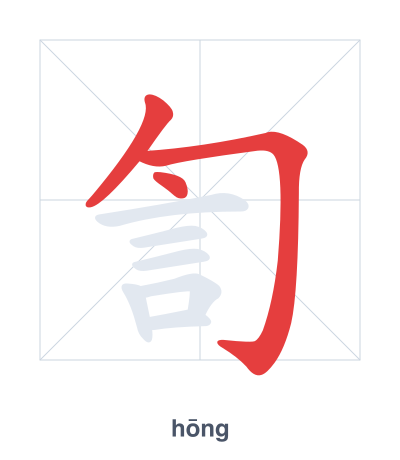
Open Hanzi Writer to see the animated stroke order and practice writing 訇 with real-time feedback.
The character 訇 (hōng) is written with 9 strokes. Follow the standard Chinese stroke order: top to bottom, left to right, outside before inside. The radical 言 is one of its key components.
Practice the correct stroke order with the Hanzi Writer app to see animated stroke-by-stroke guidance with real-time feedback.
訇 means loud crash / bang.
| Character | 訇 |
| Pinyin | hōng (hong) |
| Meaning | loud crash / bang |
| Strokes | 9 |
| Radical | 言 |
| Difficulty | 4/5 |
訇 is a compound character combining 言 (speech/sound) and 旬 (a ten-day cycle, possibly as a phonetic hint). The 言 radical links to audible noise, while 旬 suggests a prolonged or resonant quality, together depicting a loud crash or bang.
💡 Memory Tip: Imagine a mouth (言) shouting so powerfully that it wraps around the sun (日 inside 旬), creating a deafening bang.
他是一位阿訇。
tā shì yī wèi ā hōng
He is an Imam.
门訇然打开。
mén hōng rán dǎ kāi
The door burst open with a loud crash.
雷声訇訇。
léi shēng hōng hōng
The thunder rumbled loudly.
Open Hanzi Writer to see the animated stroke order and practice writing 訇 with real-time feedback.
✨ Animated stroke order · Handwriting recognition · HSK-graded practice · Free to use
訇 is a form-sound compound (形声字). The top part is the radical 言 (speech/words), which hints at the sound or utterance, and the bottom part is a phonetic component that gives the pronunciation hōng. Together they create a character meaning a loud crash or bang.