訾 (zī) means "To slander; to criticize" in Chinese. It has 13 strokes with the radical 言.
Rated 4.2/5 in difficulty (advanced).
Appears in 3+ common words including 訾议 (zī yì), 姓訾 (xìng zī), 訾毁 (zī huǐ).
Due to its 13 strokes, Hanzi Writer's error detection shows 訾 requires focused practice — most learners need 10+ attempts for consistent accuracy.
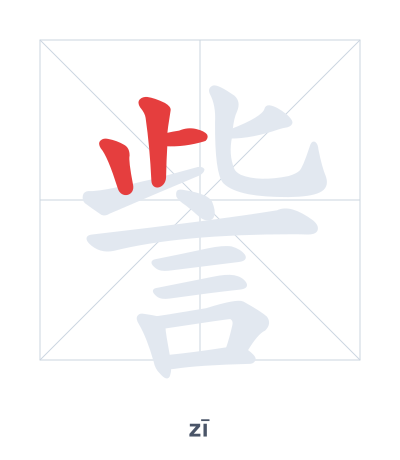
Open Hanzi Writer to see the animated stroke order and practice writing 訾 with real-time feedback.
The character 訾 (zī) is written with 13 strokes. Follow the standard Chinese stroke order: top to bottom, left to right, outside before inside. The radical 言 is one of its key components.
Practice the correct stroke order with the Hanzi Writer app to see animated stroke-by-stroke guidance with real-time feedback.
訾 means To slander; to criticize.
| Character | 訾 |
| Pinyin | zī (zi) |
| Meaning | To slander; to criticize |
| Strokes | 13 |
| Radical | 言 |
| Difficulty | 4.2/5 |
訾 is a phono-semantic compound: the radical 言 (speech) indicates the action of speaking, while 此 (cǐ, 'this') provides the sound and also suggests 'pointing at this'—together they depict verbal attacks that specifically target someone or something.
💡 Memory Tip: Imagine a gossipy person saying “This (此) speech (言) is all lies!” as they slander you.
不要随便訾议。
bú yào suí biàn zī yì
Don't criticize others casually.
我认识訾先生。
wǒ rèn shí zī xiān shēng
I know Mr. Zi.
他在訾毁别人。
tā zài zī huǐ bié rén
He is slandering others.
Open Hanzi Writer to see the animated stroke order and practice writing 訾 with real-time feedback.
✨ Animated stroke order · Handwriting recognition · HSK-graded practice · Free to use
訾 is a top-bottom character with 此 (cǐ, meaning 'this') on top and 言 (speech) on the bottom. The 言 radical indicates the meaning is related to speaking or words, while 此 gives a hint to the pronunciation (zī). Together, the character suggests 'speaking about this' in a negative way, such as slandering or criticizing.