Hanzi Writer

How to Write 詈 (lì) — Meaning “to curse”

12 strokes Radical: 言

詈 (lì) means "to curse" in Chinese. It has 12 strokes with the radical 言.

Rated 4.2/5 in difficulty (advanced).

Appears in 3+ common words including 詈骂 (lì mà), 痛詈 (tòng lì), 诟詈 (gòu lì).

Due to its 12 strokes, Hanzi Writer's error detection shows 詈 requires focused practice — most learners need 10+ attempts for consistent accuracy.
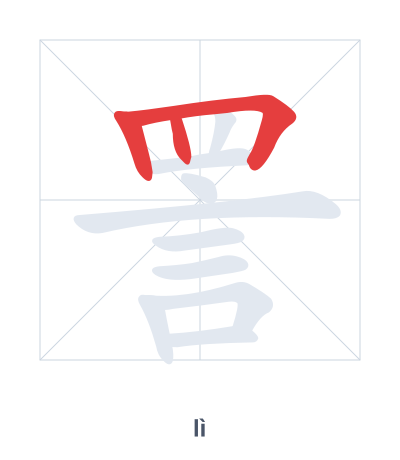
Stroke order practice for 詈 - lì

Practice Writing 詈 (lì)

Open Hanzi Writer to see the animated stroke order and practice writing 詈 with real-time feedback.

The character (lì) is written with 12 strokes. Follow the standard Chinese stroke order: top to bottom, left to right, outside before inside. The radical is one of its key components.

Practice the correct stroke order with the Hanzi Writer app to see animated stroke-by-stroke guidance with real-time feedback.

means to curse.

Character
Pinyinlì (li)
Meaningto curse
Strokes12
Radical
Difficulty4.2/5

詈 combines 言 (speech) with 罒 (a net, derived from 网 'net'), suggesting words cast like a net to ensnare or attack someone—hence 'to curse.' The ancient form shows speech (言) under a net (网), literally 'to speak with a net,' implying verbal entrapment or abuse.

💡 Memory Tip: Imagine a net (罒) of swear words flying out of your mouth (言) to trap and curse someone.

lì mà
to abuse verbally
tòng lì
severe scolding
gòu lì
to revile; to abuse

他大声詈骂。

tā dà shēng lì mà

He shouted and cursed loudly.

他被痛詈了一顿。

tā bèi tòng lì le yī dùn

He was severely scolded.

这种诟詈不对。

zhè zhǒng gòu lì bú duì

This verbal abuse is wrong.

Character Pinyin Strokes Radical
(current) 12
yín 10
13
zhān 13
Stroke order practice for 詈 - lì

Practice Writing 詈 (lì)

Open Hanzi Writer to see the animated stroke order and practice writing 詈 with real-time feedback.

✨ Animated stroke order · Handwriting recognition · HSK-graded practice · Free to use

Frequently Asked Questions about 詈

詈 is composed of 罒 (a net) on top and 言 (speech) on the bottom. The image is of casting a net of harsh words over someone, which represents verbally attacking or cursing them. This visual connection helps explain why the character means 'to curse' or 'to abuse verbally'.

Characters with Radical 言

Other 12-Stroke Characters