畔 (pàn) means "Bank, side, or field path" in Chinese. It has 10 strokes with the radical 田, and is HSK Level 7.
Rated 4.2/5 in difficulty (advanced).
Harder than 72% of HSK Level 7 characters.
Appears in 3+ common words including 河畔 (hé pàn), 湖畔 (hú pàn), 耳畔 (ěr pàn).
Due to its 10 strokes, Hanzi Writer's error detection shows 畔 requires focused practice — most learners need 10+ attempts for consistent accuracy.
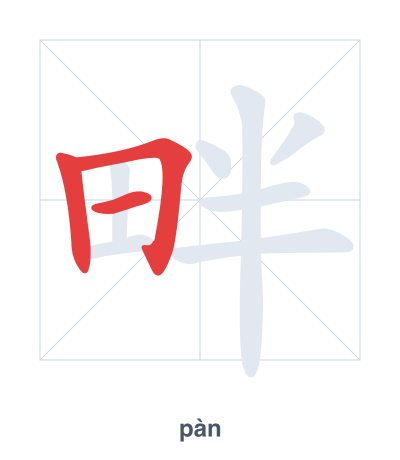
Open Hanzi Writer to see the animated stroke order and practice writing 畔 with real-time feedback.
The character 畔 (pàn) is written with 10 strokes. Follow the standard Chinese stroke order: top to bottom, left to right, outside before inside. The radical 田 is one of its key components.
Practice the correct stroke order with the Hanzi Writer app to see animated stroke-by-stroke guidance with real-time feedback.
畔 means Bank, side, or field path.
As an HSK Level 7 character, 畔 is an intermediate-level character.
畔 combines the radical 田 (field) with 半 (half), suggesting the half-edge or boundary of a field, which becomes its side or bank. In ancient usage, it referred to the path dividing fields, later extending to any edge or riverside.
💡 Memory Tip: Imagine a field (田) split in half (半) by a dirt path along its side—that path is the 畔.
我们在河畔散步。
wǒ men zài hé pàn sàn bù
We are walking by the riverside.
湖畔的风景非常美。
hú pàn de fēng jǐng fēi cháng měi
The scenery by the lake is very beautiful.
歌声在耳畔回响。
gē shēng zài ěr pàn huí xiǎng
The singing echoed in my ears.
Open Hanzi Writer to see the animated stroke order and practice writing 畔 with real-time feedback.
✨ Animated stroke order · Handwriting recognition · HSK-graded practice · Free to use
畔 is made of two parts: the radical 田 (field) on the left and 半 (half) on the right. Together they suggest the boundary or side of a field, because 半 (half) indicates a dividing line. This leads to the meaning of 'bank' or 'side' of a body of water or path.