甸 (diān/diàn) means "Suburbs" in Chinese. It has 7 strokes with the radical 田, and is HSK Level 7.
Rated 3.5/5 in difficulty (challenging).
Harder than 20% of HSK Level 7 characters.
Appears in 3+ common words including 缅甸 (miǎn diān), 沉甸甸 (chén diàn diàn), 草甸 (cǎo diān).
Due to its 7 strokes, Hanzi Writer's error detection shows 甸 requires focused practice — most learners need 10+ attempts for consistent accuracy.
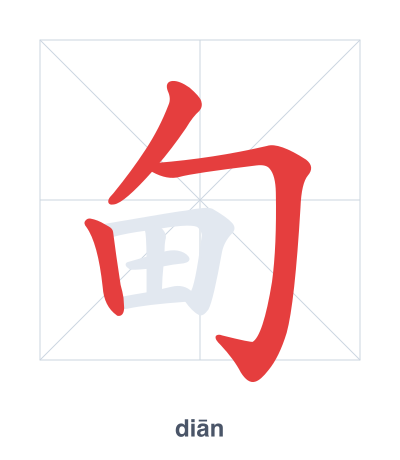
Open Hanzi Writer to see the animated stroke order and practice writing 甸 with real-time feedback.
The character 甸 (diān/diàn) is written with 7 strokes. Follow the standard Chinese stroke order: top to bottom, left to right, outside before inside. The radical 田 is one of its key components.
Practice the correct stroke order with the Hanzi Writer app to see animated stroke-by-stroke guidance with real-time feedback.
甸 means Suburbs.
This is a polyphonic character with readings: diān, diàn.
As an HSK Level 7 character, 甸 is an intermediate-level character.
The character 甸 combines the radical 田 (field) with the component 勹 (a person bending or an enclosure), originally depicting the cultivated fields surrounding a city or capital. These outer fields were designated as the suburbs, where agricultural land provided food for the urban center. Over time, 甸 specifically came to refer to the suburban areas beyond the city walls.
💡 Memory Tip: Picture a field (田) being wrapped (勹) around a city like a green belt—that's the suburbs (甸).
缅甸是中国的邻国。
miǎn diān shì zhōng guó de lín guó
Myanmar is a neighbor of China.
书包里装满了书,沉甸甸的。
shū bāo lǐ zhuāng mǎn le shū chén diàn diàn de
The schoolbag is full of books and feels very heavy.
山顶上有一片美丽的草甸。
shān dǐng shàng yǒu yī piàn měi lì de cǎo diān
There is a beautiful meadow on the mountain top.
Open Hanzi Writer to see the animated stroke order and practice writing 甸 with real-time feedback.
✨ Animated stroke order · Handwriting recognition · HSK-graded practice · Free to use
甸 is made of two parts: the outside is 勹 (bāo, meaning 'wrap' or 'enclose') and the inside is 田 (tián, 'field'). Together, they suggest a field that is wrapped or enclosed around a settlement, which is the idea of 'suburbs.'