畀 (bì) means "To give / To grant" in Chinese. It has 8 strokes with the radical 田.
Rated 3.7/5 in difficulty (challenging).
Appears in 3+ common words including 畀予 (bì yǔ), 畀付 (bì fù), 投畀 (tóu bì).
Due to its 8 strokes, Hanzi Writer's error detection shows 畀 requires focused practice — most learners need 10+ attempts for consistent accuracy.
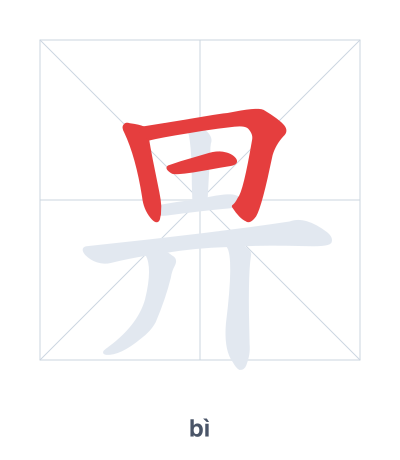
Open Hanzi Writer to see the animated stroke order and practice writing 畀 with real-time feedback.
The character 畀 (bì) is written with 8 strokes. Follow the standard Chinese stroke order: top to bottom, left to right, outside before inside. The radical 田 is one of its key components.
Practice the correct stroke order with the Hanzi Writer app to see animated stroke-by-stroke guidance with real-time feedback.
畀 means To give / To grant.
The character 畀 originally depicted a field (田) with a plow or implement (the lower part) being granted to someone, symbolizing the act of giving land. Over time, it generalized to mean 'to give' or 'to grant.'
💡 Memory Tip: Imagine a farmer giving away his field (田) by placing it on a small pedestal (the lower part of 畀) as a gift.
畀予他这个机会。
bì yǔ tā zhè ge jī huì
Grant him this opportunity.
畀付重任给他。
bì fù zhòng rèn gěi tā
Entrust him with a heavy responsibility.
投畀豺虎。
tóu bì chái hǔ
Throw them to the wolves and tigers.
Open Hanzi Writer to see the animated stroke order and practice writing 畀 with real-time feedback.
✨ Animated stroke order · Handwriting recognition · HSK-graded practice · Free to use
The character 畀 is composed of 田 (field) on top and 由 (cause/reason) below. The vertical stroke of 由 extends upward through the 田, connecting both parts. This structure suggests the idea of giving or granting something from a field as a source.