甹 (pīng) means "To rush" in Chinese. It has 7 strokes with the radical 田.
Rated 3.2/5 in difficulty (challenging).
Appears in 3+ common words including 甹侠 (pīng xiá), 甹听 (pīng tīng), 甹甹 (pīng pīng).
Due to its 7 strokes, Hanzi Writer's error detection shows 甹 requires focused practice — most learners need 10+ attempts for consistent accuracy.
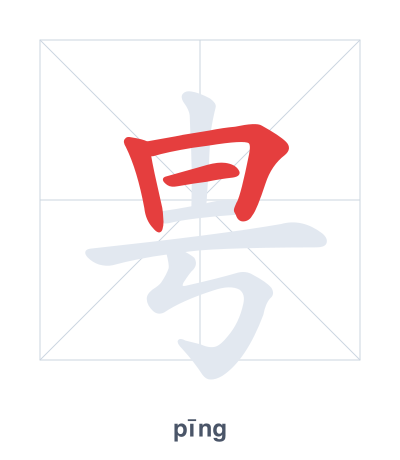
Open Hanzi Writer to see the animated stroke order and practice writing 甹 with real-time feedback.
The character 甹 (pīng) is written with 7 strokes. Follow the standard Chinese stroke order: top to bottom, left to right, outside before inside. The radical 田 is one of its key components.
Practice the correct stroke order with the Hanzi Writer app to see animated stroke-by-stroke guidance with real-time feedback.
甹 means To rush.
甹 combines 田 (field) and 丂, an ancient pictograph of a person bending forward in exertion. Together they depict someone rushing urgently across a field, striving to move quickly.
💡 Memory Tip: Picture a field (田) where a runner bends low (丂) to sprint with all their might—that's rushing (甹).
他是一个甹侠。
tā shì yí gè pīng xiá
He is a chivalrous person.
请大家甹听。
qǐng dà jiā pīng tīng
Everyone, please listen attentively.
甹甹之声不断。
pīng pīng zhī shēng bù duàn
The sound of rushing continues.
Open Hanzi Writer to see the animated stroke order and practice writing 甹 with real-time feedback.
✨ Animated stroke order · Handwriting recognition · HSK-graded practice · Free to use
The character 甹 is composed of two parts: the radical 田 (tian, meaning "field") on top and the component 丂 (kǎo) below. The radical indicates the character belongs to the "field" category, but the meaning "to rush" does not directly come from these parts. It is best understood as a phonetic-semantic compound where 丂 provides sound hints.