恧 (nǜ) means "ashamed" in Chinese. It has 10 strokes with the radical 心.
Rated 4.2/5 in difficulty (advanced).
Appears in 3+ common words including 愧恧 (kuì nǜ), 恧然 (nǜ rán), 莫恧 (mò nǜ).
Due to its 10 strokes, Hanzi Writer's error detection shows 恧 requires focused practice — most learners need 10+ attempts for consistent accuracy.
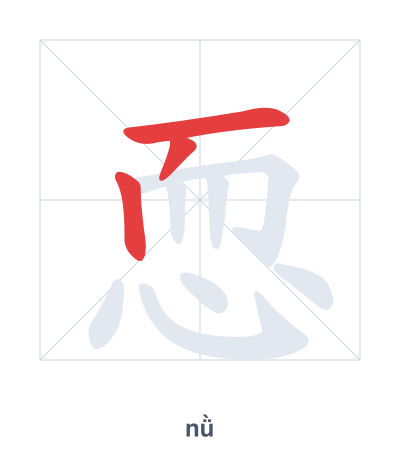
Open Hanzi Writer to see the animated stroke order and practice writing 恧 with real-time feedback.
The character 恧 (nǜ) is written with 10 strokes. Follow the standard Chinese stroke order: top to bottom, left to right, outside before inside. The radical 心 is one of its key components.
Practice the correct stroke order with the Hanzi Writer app to see animated stroke-by-stroke guidance with real-time feedback.
恧 means ashamed.
恧 is a phono-semantic compound: the bottom component 心 (heart) indicates that shame is an inner feeling, while the top component 而 originally served as a phonetic hint (though the modern pronunciations differ). The character thus visually places the idea of a shameful emotion directly in the heart.
💡 Memory Tip: Picture a drooping head (而) hanging low over a heavy heart (心), too embarrassed to lift its eyes.
他感到十分愧恧。
tā gǎn dào shí fēn kuì nǜ
He felt very ashamed.
他恧然低下了头。
tā nǜ rán dī xià le tóu
He lowered his head in shame.
你不必感到莫恧。
nǐ bù bì gǎn dào mò nǜ
You don't need to feel ashamed.
Open Hanzi Writer to see the animated stroke order and practice writing 恧 with real-time feedback.
✨ Animated stroke order · Handwriting recognition · HSK-graded practice · Free to use
恧 is composed of the radical 心 (heart/mind) at the bottom, which connects to emotions like shame. The upper part is 而 (ér, meaning 'and' or 'yet'), but here it mainly gives the sound. Together, the character suggests a feeling of shame that arises from the heart.