喏 (nuò) means "look / here (interjection)" in Chinese. It has 11 strokes with the radical 口.
Rated 4.2/5 in difficulty (advanced).
Appears in 1+ common words including 喏 (nuò).
Due to its 11 strokes, Hanzi Writer's error detection shows 喏 requires focused practice — most learners need 10+ attempts for consistent accuracy.
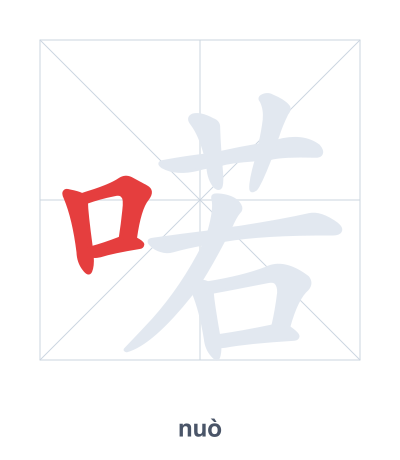
Open Hanzi Writer to see the animated stroke order and practice writing 喏 with real-time feedback.
The character 喏 (nuò) is written with 11 strokes. Follow the standard Chinese stroke order: top to bottom, left to right, outside before inside. The radical 口 is one of its key components.
Practice the correct stroke order with the Hanzi Writer app to see animated stroke-by-stroke guidance with real-time feedback.
喏 means look / here (interjection).
喏 is a compound character with the mouth radical (口) indicating speech, and 若 (ruò) as the phonetic component. It originally functioned as an exclamation of respectful acknowledgment in classical Chinese, later evolving to mean 'look' or 'here' when drawing someone's attention.
💡 Memory Tip: Picture a person (若) with a wide-open mouth (口) pointing and shouting 'Look here!' at a flower (艹) on their right (右).
喏,你的书在这里。
nuò nǐ de shū zài zhè lǐ
Look, your book is here.
喏,给你钱。
nuò gěi nǐ qián
Here, here's the money.
喏,就在那儿。
nuò jiù zài nà ér
Look, it's right there.
Open Hanzi Writer to see the animated stroke order and practice writing 喏 with real-time feedback.
✨ Animated stroke order · Handwriting recognition · HSK-graded practice · Free to use
喏 is a left-right structure made of the radical 口 (mouth) on the left and 若 on the right. The 口 radical indicates that this character is an interjection or sound made by the mouth, while 若 (ruò, meaning "like" or "if") gives the character its pronunciation (nuò). Together, the character represents a sound you make to draw attention, like saying "look" or "here."