咛 (níng) means "to enjoin; to urge" in Chinese. It has 8 strokes with the radical 口.
Rated 3.7/5 in difficulty (challenging).
Appears in 3+ common words including 叮咛 (dīng níng), 咛嘱 (níng zhǔ), 叮咛声 (dīng níng shēng).
Due to its 8 strokes, Hanzi Writer's error detection shows 咛 requires focused practice — most learners need 10+ attempts for consistent accuracy.
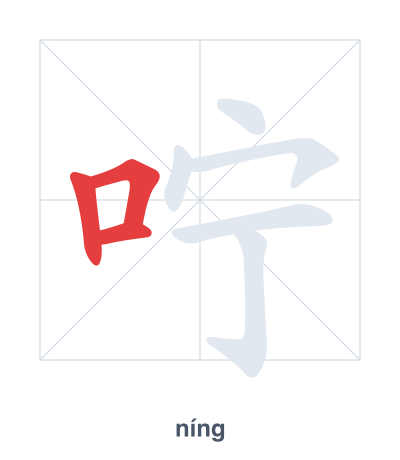
Open Hanzi Writer to see the animated stroke order and practice writing 咛 with real-time feedback.
The character 咛 (níng) is written with 8 strokes. Follow the standard Chinese stroke order: top to bottom, left to right, outside before inside. The radical 口 is one of its key components.
Practice the correct stroke order with the Hanzi Writer app to see animated stroke-by-stroke guidance with real-time feedback.
咛 means to enjoin; to urge.
咛 is a phono-semantic compound. The left radical 口 (mouth) indicates speaking or urging, while the right component 宁 (níng) provides the pronunciation and may loosely suggest the idea of 'peacefully insisting' (宁 can mean 'peaceful'). Together, the character depicts using one's mouth to repeatedly enjoin or urge someone.
💡 Memory Tip: Imagine a mouth (口) that keeps saying 'Ning! Ning!' to urge someone to settle down (宁 suggests peace).
妈妈反复叮咛。
mā mā fǎn fù dīng níng
Mom gave repeated instructions.
老师再三咛嘱。
lǎo shī zài sān níng zhǔ
The teacher repeatedly exhorted us.
叮咛声在耳边。
dīng níng shēng zài ěr biān
The sound of reminders lingers in my ears.
Open Hanzi Writer to see the animated stroke order and practice writing 咛 with real-time feedback.
✨ Animated stroke order · Handwriting recognition · HSK-graded practice · Free to use
咛 combines the radical 口 (mouth) on the left with 宁 (níng, meaning peace) on the right. The mouth radical indicates that the character involves speech, while 宁 provides the sound and suggests a gentle, peaceful tone. Together they represent using one's mouth to give repeated, caring urgings.