嗫 (niè) means "To move the lips as if to speak." in Chinese. It has 13 strokes with the radical 口.
Rated 4.2/5 in difficulty (advanced).
Appears in 3+ common words including 嗫嚅 (niè rú), 嗫嗫 (niè niè), 嗫嚅道 (niè rú dào).
Due to its 13 strokes, Hanzi Writer's error detection shows 嗫 requires focused practice — most learners need 10+ attempts for consistent accuracy.
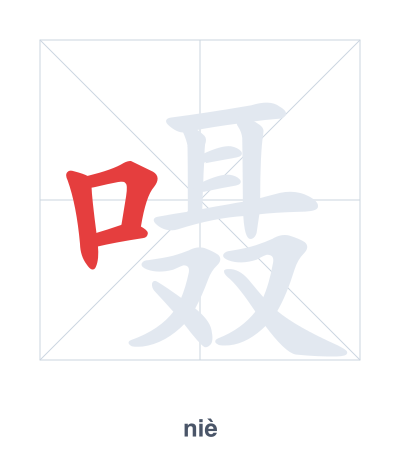
Open Hanzi Writer to see the animated stroke order and practice writing 嗫 with real-time feedback.
The character 嗫 (niè) is written with 13 strokes. Follow the standard Chinese stroke order: top to bottom, left to right, outside before inside. The radical 口 is one of its key components.
Practice the correct stroke order with the Hanzi Writer app to see animated stroke-by-stroke guidance with real-time feedback.
嗫 means To move the lips as if to speak..
嗫 is a compound character: the left radical 口 (mouth) indicates speech, while the right component 聂 (niè) originally meant 'to whisper'—it combines 耳 (ear) and 双 (two hands), suggesting cupping hands around the ear to speak softly. Together, the character depicts moving the lips to speak in a low, hesitant manner.
💡 Memory Tip: Imagine a mouth (口) trembling like two ears (耳) held by hands (双), barely whispering 'niè' as it moves its lips.
他嗫嚅着说不出话。
tā niè rú zhe shuō bù chū huà
He stammered and was unable to speak.
她嗫嗫地低下了头。
tā niè niè dì dī xià le tóu
She lowered her head timidly.
他嗫嚅道:“对不起”。
tā niè rú dào duì bù qǐ
He murmured, 'I'm sorry.'
Open Hanzi Writer to see the animated stroke order and practice writing 嗫 with real-time feedback.
✨ Animated stroke order · Handwriting recognition · HSK-graded practice · Free to use
Left side is 口 (mouth), showing it is mouth-related. Right side is 聂 (niè), which gives a hint of the pronunciation and also suggests a quiet, hesitant action. Together, the character means moving the lips without making a clear sound.