逆 (nì) means "contrary; reverse; to go against" in Chinese. It has 9 strokes with the radical 辶, and is HSK Level 7.
Rated 4/5 in difficulty (challenging).
Harder than 46% of HSK Level 7 characters.
Appears in 3+ common words including 逆风 (nì fēng), 叛逆 (pàn nì), 逆转 (nì zhuǎn).
Due to its 9 strokes, Hanzi Writer's error detection shows 逆 requires focused practice — most learners need 10+ attempts for consistent accuracy.
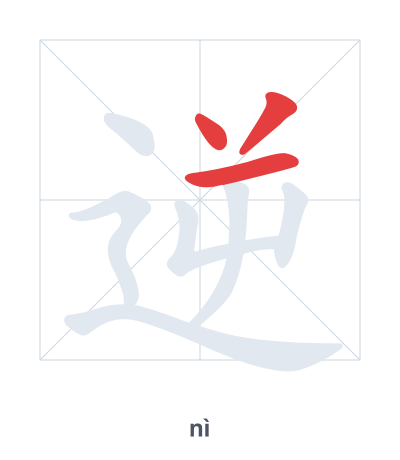
Open Hanzi Writer to see the animated stroke order and practice writing 逆 with real-time feedback.
The character 逆 (nì) is written with 9 strokes. Follow the standard Chinese stroke order: top to bottom, left to right, outside before inside. The radical 辶 is one of its key components.
Practice the correct stroke order with the Hanzi Writer app to see animated stroke-by-stroke guidance with real-time feedback.
逆 means contrary; reverse; to go against.
As an HSK Level 7 character, 逆 is an intermediate-level character.
The character 逆 combines the radical 辶 (walk/action) with 屰, which originally depicted a person upside down or reversed. Together, they convey the idea of moving in a direction opposed to normal—going against the flow. In ancient forms, 屰 showed an inverted person, reinforcing the meaning of 'contrary' or 'reverse.'
💡 Memory Tip: Picture a rebel (屰) walking backwards (辶) upstream, stubbornly opposing the current.
骑车逆风很辛苦。
qí chē nì fēng hěn xīn kǔ
Riding a bike against the wind is very hard work.
那个孩子很叛逆。
nà ge hái zi hěn pàn nì
That child is very rebellious.
比赛结果逆转了。
bǐ sài jié guǒ nì zhuǎn le
The match result was reversed.
Open Hanzi Writer to see the animated stroke order and practice writing 逆 with real-time feedback.
✨ Animated stroke order · Handwriting recognition · HSK-graded practice · Free to use
The left part '辶' means 'to walk' or 'movement,' and the right part '屰' is a phonetic component that also suggests 'reverse' or 'oppose.' Combined, they create the idea of moving in the opposite or contrary direction, which matches the meaning of 'to go against.'