叛 (pàn) means "to rebel or betray" in Chinese. It has 9 strokes with the radical 又, and is HSK Level 7.
Rated 3.7/5 in difficulty (challenging).
Harder than 23% of HSK Level 7 characters.
Appears in 3+ common words including 叛逆 (pàn nì), 背叛 (bèi pàn), 叛变 (pàn biàn).
Due to its 9 strokes, Hanzi Writer's error detection shows 叛 requires focused practice — most learners need 10+ attempts for consistent accuracy.
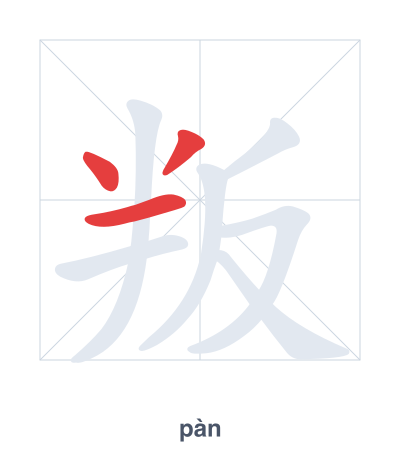
Open Hanzi Writer to see the animated stroke order and practice writing 叛 with real-time feedback.
The character 叛 (pàn) is written with 9 strokes. Follow the standard Chinese stroke order: top to bottom, left to right, outside before inside. The radical 又 is one of its key components.
Practice the correct stroke order with the Hanzi Writer app to see animated stroke-by-stroke guidance with real-time feedback.
叛 means to rebel or betray.
As an HSK Level 7 character, 叛 is an intermediate-level character.
叛 combines 半 (half, suggesting division) with 又 (hand, indicating action). The hand 'halving' or pulling apart represents the act of breaking away, rebellion, or betrayal.
💡 Memory Tip: Imagine a hand (又) splitting a group in half (半) by turning against them.
他正处于叛逆期。
tā zhèng chǔ yú pàn nì qī
He is in his rebellious phase.
他背叛了我的信任。
tā bèi pàn le wǒ de xìn rèn
He betrayed my trust.
那名士兵叛变了。
nà míng shì bīng pàn biàn le
That soldier defected.
Open Hanzi Writer to see the animated stroke order and practice writing 叛 with real-time feedback.
✨ Animated stroke order · Handwriting recognition · HSK-graded practice · Free to use
叛 is made of two parts: left side 半 (meaning "half") and right side 反 (meaning "oppose" or "against"). Together they suggest a situation where half the people oppose authority, which connects to the idea of rebelling or betraying.