某 (mǒu) means "Certain, some, or so-and-so." in Chinese. It has 9 strokes with the radical 木, and is HSK Level 3.
Rated 4/5 in difficulty (challenging).
Harder than 64% of HSK Level 3 characters.
Appears in 3+ common words including 某人 (mǒu rén), 某些 (mǒu xiē), 某天 (mǒu tiān).
Due to its 9 strokes, Hanzi Writer's error detection shows 某 requires focused practice — most learners need 10+ attempts for consistent accuracy.
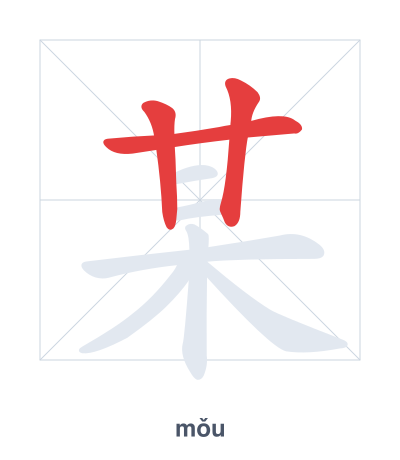
Open Hanzi Writer to see the animated stroke order and practice writing 某 with real-time feedback.
The character 某 (mǒu) is written with 9 strokes. Follow the standard Chinese stroke order: top to bottom, left to right, outside before inside. The radical 木 is one of its key components.
Practice the correct stroke order with the Hanzi Writer app to see animated stroke-by-stroke guidance with real-time feedback.
某 means Certain, some, or so-and-so..
As an HSK Level 3 character, 某 is an intermediate-level character.
某 originally depicted a fruit hanging from a tree (木), with the top part 甘 representing sweetness; over time, it was borrowed as a placeholder word meaning 'certain' or 'so-and-so'.
💡 Memory Tip: Imagine a sweet plum (甘) hanging on a tree (木), and you point to it and say, 'That certain fruit is for so-and-so.'
某人想见你。
mǒu rén xiǎng jiàn nǐ
Someone wants to see you.
某些地方非常漂亮。
mǒu xiē dì fāng fēi cháng piào liàng
Some places are very beautiful.
我某天在街上遇到了他。
wǒ mǒu tiān zài jiē shàng yù dào le tā
I met him on the street one day.
Open Hanzi Writer to see the animated stroke order and practice writing 某 with real-time feedback.
✨ Animated stroke order · Handwriting recognition · HSK-graded practice · Free to use
某 is made of two parts: the radical 木 (tree) at the bottom and 甘 (sweet) on top. Originally it referred to a type of fruit tree, but today its meaning "certain" or "some" comes from its use as a pronoun for unspecified things. The tree radical remains as a visual reminder of its origin.