螟 (míng) means "Stem borer / Moth larva" in Chinese. It has 16 strokes with the radical 虫.
Rated 4.2/5 in difficulty (advanced).
Appears in 3+ common words including 螟虫 (míng chóng), 螟蛾 (míng é), 防治螟虫 (fáng zhì míng chóng).
Due to its 16 strokes, Hanzi Writer's error detection shows 螟 requires focused practice — most learners need 10+ attempts for consistent accuracy.
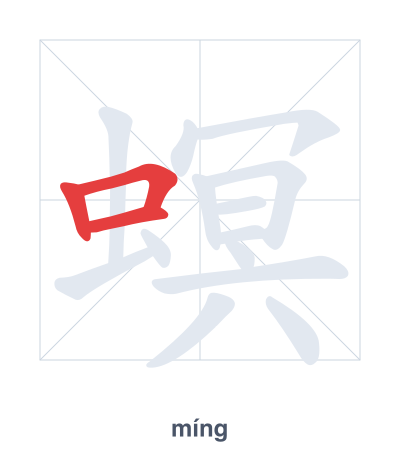
Open Hanzi Writer to see the animated stroke order and practice writing 螟 with real-time feedback.
The character 螟 (míng) is written with 16 strokes. Follow the standard Chinese stroke order: top to bottom, left to right, outside before inside. The radical 虫 is one of its key components.
Practice the correct stroke order with the Hanzi Writer app to see animated stroke-by-stroke guidance with real-time feedback.
螟 means Stem borer / Moth larva.
This compound character combines the insect radical 虫 (chóng) with the phonetic component 冥 (míng, meaning 'dark' or 'deep'). The stem borer moth larva lives hidden deep inside plant stems, hence the association with darkness.
💡 Memory Tip: Imagine a tiny insect (虫) crawling into the dark cave (冥) inside a plant stem to hide as a borer larva.
螟虫吃了庄稼。
míng chóng chī le zhuāng jià
Stem borers ate the crops.
这种螟蛾很常见。
zhè zhǒng míng é hěn cháng jiàn
This snout moth is very common.
农民在防治螟虫。
nóng mín zài fáng zhì míng chóng
Farmers are controlling stem borers.
Open Hanzi Writer to see the animated stroke order and practice writing 螟 with real-time feedback.
✨ Animated stroke order · Handwriting recognition · HSK-graded practice · Free to use
螟 is composed of the radical 虫 (insect) on the left and the phonetic component 冥 (míng, meaning 'dark' or 'deep') on the right. The insect radical indicates it is a type of insect, while 冥 hints at the pest's habitat inside dark plant stems. Together they form the meaning 'stem borer' or 'moth larva'.