觅 (mì) means "To seek; to look for" in Chinese. It has 8 strokes with the radical 见, and is HSK Level 7.
Rated 3.7/5 in difficulty (challenging).
Harder than 31% of HSK Level 7 characters.
Appears in 3+ common words including 寻觅 (xún mì), 觅食 (mì shí), 觅得 (mì dé).
Due to its 8 strokes, Hanzi Writer's error detection shows 觅 requires focused practice — most learners need 10+ attempts for consistent accuracy.
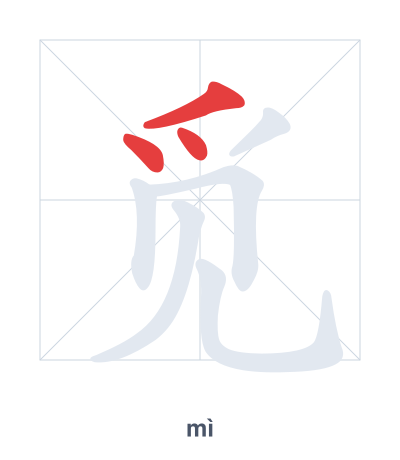
Open Hanzi Writer to see the animated stroke order and practice writing 觅 with real-time feedback.
The character 觅 (mì) is written with 8 strokes. Follow the standard Chinese stroke order: top to bottom, left to right, outside before inside. The radical 见 is one of its key components.
Practice the correct stroke order with the Hanzi Writer app to see animated stroke-by-stroke guidance with real-time feedback.
觅 means To seek; to look for.
As an HSK Level 7 character, 觅 is an intermediate-level character.
觅 combines a hand (爪, a claw-like hand) above 见 (to see), literally picturing 'using your hand and eye to search'—reaching out while looking carefully. The ancient form shows a hand over an eye, emphasizing active seeking rather than passive seeing.
💡 Memory Tip: Imagine a claw (爪) reaching out while an eye (见) scans the ground—you're 'seeking' something hidden.
他在寻觅新的机会。
tā zài xún mì xīn de jī huì
He is seeking new opportunities.
小鸟在草地上觅食。
xiǎo niǎo zài cǎo dì shàng mì shí
The little bird is foraging on the grass.
他终于觅得良师益友。
tā zhōng yú mì dé liáng shī yì yǒu
He finally found a good teacher and friend.
Open Hanzi Writer to see the animated stroke order and practice writing 觅 with real-time feedback.
✨ Animated stroke order · Handwriting recognition · HSK-graded practice · Free to use
觅 is made of the radical 见 (see) at the bottom and a claw-like component 爫 on top. The top component suggests using a hand or claw to search, while 见 shows the act of seeing — together they mean 'to seek or look for something carefully'.