觇 (chān) means "To peep; to spy; to observe" in Chinese. It has 9 strokes with the radical 见.
Rated 4/5 in difficulty (challenging).
Appears in 3+ common words including 觇看 (chān kàn), 觇察 (chān chá), 觇视 (chān shì).
Due to its 9 strokes, Hanzi Writer's error detection shows 觇 requires focused practice — most learners need 10+ attempts for consistent accuracy.
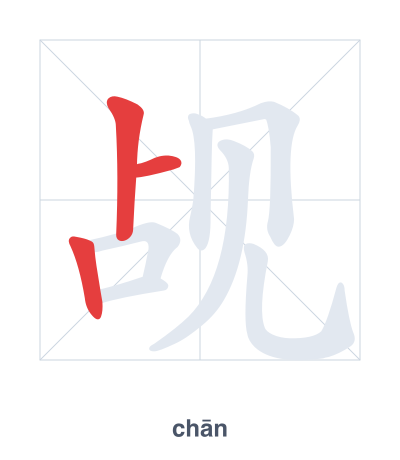
Open Hanzi Writer to see the animated stroke order and practice writing 觇 with real-time feedback.
The character 觇 (chān) is written with 9 strokes. Follow the standard Chinese stroke order: top to bottom, left to right, outside before inside. The radical 见 is one of its key components.
Practice the correct stroke order with the Hanzi Writer app to see animated stroke-by-stroke guidance with real-time feedback.
觇 means To peep; to spy; to observe.
| Character | 觇 |
| Pinyin | chān (chan) |
| Meaning | To peep; to spy; to observe |
| Strokes | 9 |
| Radical | 见 |
| Difficulty | 4/5 |
觇 combines 占 (divining or observing signs) with 见 (to see), suggesting a secretive, watchful look—like spying by reading hidden clues. The left component 占 originally shows a mouth (口) over a divination mark (卜), indicating an oracular gaze, while 见 reinforces the act of seeing. Together they form the idea of peeping or observing covertly.
💡 Memory Tip: Imagine a spy using a telescope (the 占 part looks like a lens on a stand) to see (见) into a restricted area.
他在门外向里觇看。
tā zài mén wài xiàng lǐ chān kàn
He is peeping inside from outside the door.
我们需要觇察地形。
wǒ men xū yào chān chá dì xíng
We need to scout the terrain.
他四处觇视,寻找机会。
tā sì chù chān shì xún zhǎo jī huì
He peered around, looking for an opportunity.
Open Hanzi Writer to see the animated stroke order and practice writing 觇 with real-time feedback.
✨ Animated stroke order · Handwriting recognition · HSK-graded practice · Free to use
觇 consists of 占 (zhàn, meaning 'to divine' or 'occupy') on the left and 见 (jiàn, 'to see') on the right. Together, they suggest secretly observing or peeping at something, like a diviner peering into the unknown. The radical 见 emphasizes the act of seeing, while 占 adds a sense of stealth or careful attention.