觌 (dí) means "To meet; to see" in Chinese. It has 12 strokes with the radical 见.
Rated 4.2/5 in difficulty (advanced).
Appears in 3+ common words including 觌面 (dí miàn), 见觌 (jiàn dí), 觌武 (dí wǔ).
Due to its 12 strokes, Hanzi Writer's error detection shows 觌 requires focused practice — most learners need 10+ attempts for consistent accuracy.
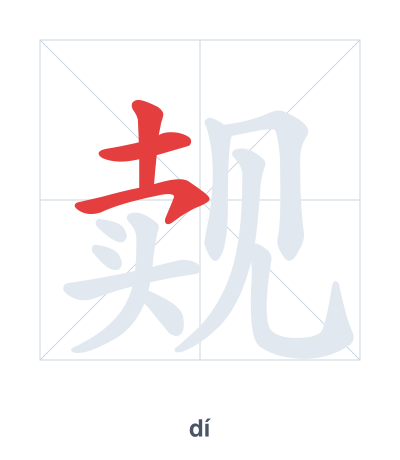
Open Hanzi Writer to see the animated stroke order and practice writing 觌 with real-time feedback.
The character 觌 (dí) is written with 12 strokes. Follow the standard Chinese stroke order: top to bottom, left to right, outside before inside. The radical 见 is one of its key components.
Practice the correct stroke order with the Hanzi Writer app to see animated stroke-by-stroke guidance with real-time feedback.
觌 means To meet; to see.
| Character | 觌 |
| Pinyin | dí (di) |
| Meaning | To meet; to see |
| Strokes | 12 |
| Radical | 见 |
| Difficulty | 4.2/5 |
觌 is a compound character: the radical 见 (to see) conveys the meaning of seeing or meeting, while the component 卖 (originally 賣, providing the phonetic hint dí) suggests the sound. Together, it implies a direct, face-to-face encounter or visual meeting.
💡 Memory Tip: Picture a vendor (卖) waving at you as you see (见) them, signaling a face-to-face meeting (觌).
两人终于觌面交谈了。
liǎng rén zhōng yú dí miàn jiāo tán le
The two finally met and talked face-to-face.
他希望能与好友见觌。
tā xī wàng néng yǔ hǎo yǒu jiàn dí
He hopes to meet with his good friend.
古代用觌武展示力量。
gǔ dài yòng dí wǔ zhǎn shì lì liàng
Ancient times used military displays to show power.
Open Hanzi Writer to see the animated stroke order and practice writing 觌 with real-time feedback.
✨ Animated stroke order · Handwriting recognition · HSK-graded practice · Free to use
The character 觌 is made of the left part 卖 (mài, to sell) and the right radical 见 (jiàn, to see). The radical 见 directly links to the meaning of seeing or meeting. The left part 卖 may provide a phonetic hint, and together they suggest seeing someone in a business or personal meeting context.