茫 (máng) means "vast" in Chinese. It has 9 strokes with the radical 艹, and is HSK Level 7.
Rated 4/5 in difficulty (challenging).
Harder than 45% of HSK Level 7 characters.
Appears in 3+ common words including 茫然 (máng rán), 茫茫 (máng máng), 苍茫 (cāng máng).
Due to its 9 strokes, Hanzi Writer's error detection shows 茫 requires focused practice — most learners need 10+ attempts for consistent accuracy.
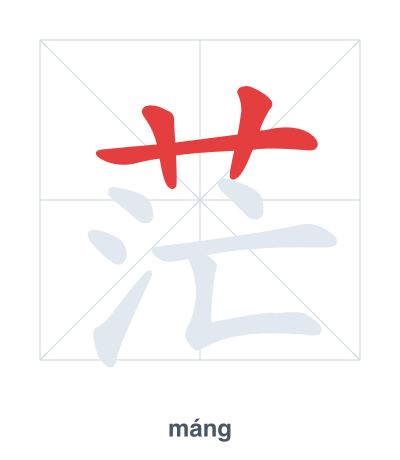
Open Hanzi Writer to see the animated stroke order and practice writing 茫 with real-time feedback.
The character 茫 (máng) is written with 9 strokes. Follow the standard Chinese stroke order: top to bottom, left to right, outside before inside. The radical 艹 is one of its key components.
Practice the correct stroke order with the Hanzi Writer app to see animated stroke-by-stroke guidance with real-time feedback.
茫 means vast.
As an HSK Level 7 character, 茫 is an intermediate-level character.
茫 combines the grass radical 艹 with water 氵 and the phonetic element 亡 (wáng), originally depicting a vast, boundless expanse of water and plants. The imagery evokes a sea of grass or endless water, reinforcing the meaning of 'vast' or 'boundless.'
💡 Memory Tip: Imagine a vast field of grass (艹) next to a river (氵) that has lost its way (亡), stretching endlessly into the horizon.
他茫然地看着我。
tā máng rán dì kàn zhe wǒ
He looked at me blankly.
大海上茫茫一片。
dà hǎi shàng máng máng yī piàn
The sea is a vast expanse.
暮色显得很苍茫。
mù sè xiǎn de hěn cāng máng
The twilight looks vast and hazy.
Open Hanzi Writer to see the animated stroke order and practice writing 茫 with real-time feedback.
✨ Animated stroke order · Handwriting recognition · HSK-graded practice · Free to use
茫 is a top-bottom structure. The top radical 艹 (grass) suggests plants or nature, and the bottom 汒 (máng, not a standalone character) provides sound while hinting at vastness. Together, they create the meaning of something vast and boundless, like grass stretching far into the distance.