惶 (huáng) means "fearful" in Chinese. It has 12 strokes with the radical 忄.
Rated 4.2/5 in difficulty (advanced).
Appears in 3+ common words including 惶恐 (huáng kǒng), 惊惶失措 (jīng huáng shī cuò), 人心惶惶 (rén xīn huáng huáng).
Due to its 12 strokes, Hanzi Writer's error detection shows 惶 requires focused practice — most learners need 10+ attempts for consistent accuracy.
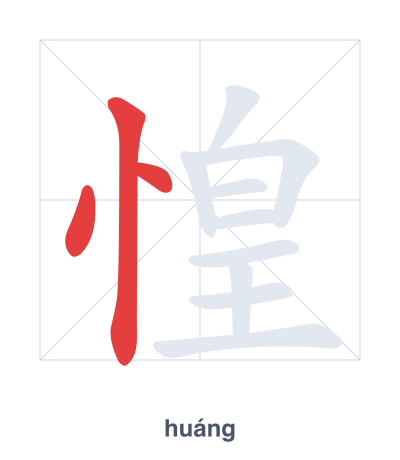
Open Hanzi Writer to see the animated stroke order and practice writing 惶 with real-time feedback.
The character 惶 (huáng) is written with 12 strokes. Follow the standard Chinese stroke order: top to bottom, left to right, outside before inside. The radical 忄 is one of its key components.
Practice the correct stroke order with the Hanzi Writer app to see animated stroke-by-stroke guidance with real-time feedback.
惶 means fearful.
惶 combines the heart radical 忄 (xīn), indicating emotion, with 皇 (huáng), 'emperor,' which also provides the sound. The heart trembling before the emperor evokes the meaning of fear or anxiety.
💡 Memory Tip: Picture your heart (忄) pounding wildly in terror as you bow before the emperor (皇).
他的表情很惶恐。
tā de biǎo qíng hěn huáng kǒng
His expression was terrified.
别再惊惶失措了。
bié zài jīng huáng shī cuò le
Stop panicking.
消息让人心惶惶。
xiāo xī ràng rén xīn huáng huáng
The news makes people feel anxious.
Open Hanzi Writer to see the animated stroke order and practice writing 惶 with real-time feedback.
✨ Animated stroke order · Handwriting recognition · HSK-graded practice · Free to use
惶 is made of the heart radical 忄 on the left and 皇 on the right. The heart radical shows this character relates to emotions, and 皇 (meaning "emperor" or "royal") gives the sound "huáng" and suggests the overwhelming feeling of fear one might have before a powerful figure.