颟 (mān) means "Muddled; careless" in Chinese. It has 16 strokes with the radical 页.
Rated 4.2/5 in difficulty (advanced).
Appears in 3+ common words including 颟顸 (mān hān), 别颟顸 (bié mān hān), 颟顸无能 (mān hān wú néng).
Due to its 16 strokes, Hanzi Writer's error detection shows 颟 requires focused practice — most learners need 10+ attempts for consistent accuracy.
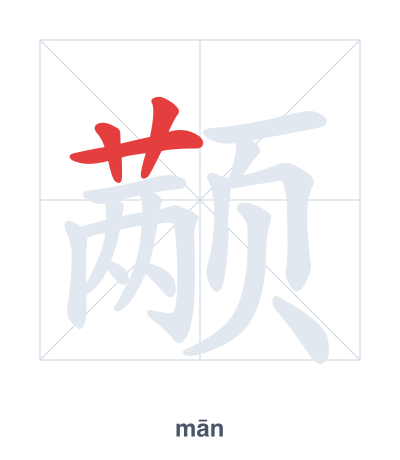
Open Hanzi Writer to see the animated stroke order and practice writing 颟 with real-time feedback.
The character 颟 (mān) is written with 16 strokes. Follow the standard Chinese stroke order: top to bottom, left to right, outside before inside. The radical 页 is one of its key components.
Practice the correct stroke order with the Hanzi Writer app to see animated stroke-by-stroke guidance with real-time feedback.
颟 means Muddled; careless.
颟 is a phono-semantic compound. The radical 页 (head) indicates the meaning relates to the head or face, while the component 㒼 (mán) provides the sound and adds the idea of 'covered' or 'obscured'. Together, they suggest a head that is covered or clouded, leading to a state of being muddled or careless.
💡 Memory Tip: Picture a head (页) covered by a messy, tangled blanket (㒼) so the person can't think clearly, acting muddled and careless.
他办事很颟顸。
tā bàn shì hěn mān hān
He is very muddle-headed in his work.
你别这么颟顸。
nǐ bié zhè me mān hān
Don't be so muddle-headed.
他表现得颟顸无能。
tā biǎo xiàn dé mān hān wú néng
He showed he was muddle-headed and incompetent.
Open Hanzi Writer to see the animated stroke order and practice writing 颟 with real-time feedback.
✨ Animated stroke order · Handwriting recognition · HSK-graded practice · Free to use
颟 is made of the radical 页 (head) on the right and the phonetic component 㒼 (not an independent character) on the left. The radical 页 suggests something related to the head or face, while the overall character implies a muddled or careless state of mind.