绿 (lǜ) means "green" in Chinese. It has 11 strokes with the radical 纟, and is HSK Level 2.
Rated 3.7/5 in difficulty (challenging).
Harder than 91% of HSK Level 2 characters.
Appears in 3+ common words including 绿色 (lǜ sè), 绿茶 (lǜ chá), 绿地 (lǜ dì).
Due to its 11 strokes, Hanzi Writer's error detection shows 绿 requires focused practice — most learners need 10+ attempts for consistent accuracy.
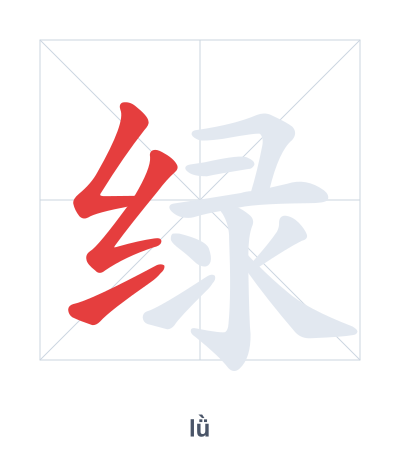
Open Hanzi Writer to see the animated stroke order and practice writing 绿 with real-time feedback.
The character 绿 (lǜ) is written with 11 strokes. Follow the standard Chinese stroke order: top to bottom, left to right, outside before inside. The radical 纟 is one of its key components.
Practice the correct stroke order with the Hanzi Writer app to see animated stroke-by-stroke guidance with real-time feedback.
绿 means green.
As an HSK Level 2 character, 绿 is among the first characters beginners learn.
绿 is a phono-semantic compound: the radical 纟 (silk) indicates it relates to dyeing or colored cloth, while 录 (lù) provides the pronunciation. It originally referred to the green color of dyed silk or fabric.
💡 Memory Tip: Picture a green silk thread (纟) that has recorded (录) every shade of green it has ever dyed.
我最喜欢绿色。
wǒ zuì xǐ huān lǜ sè
Green is my favorite color.
你喝绿茶还是红茶?
nǐ hē lǜ chá hái shì hóng chá
Do you drink green tea or black tea?
公园里有一片绿地。
gōng yuán lǐ yǒu yī piàn lǜ dì
There is a green space in the park.
Open Hanzi Writer to see the animated stroke order and practice writing 绿 with real-time feedback.
✨ Animated stroke order · Handwriting recognition · HSK-graded practice · Free to use
绿 is made of the radical 纟 (silk thread) on the left and the phonetic component 录 (lù) on the right. The silk radical links it to colors like green because ancient Chinese dyed silk green. The right part 录 gives a clue to the pronunciation lǜ.