禄 (lù) means "Official's salary; prosperity." in Chinese. It has 12 strokes with the radical 礻.
Rated 4.2/5 in difficulty (advanced).
Appears in 3+ common words including 福禄 (fú lù), 俸禄 (fèng lù), 功名利禄 (gōng míng lì lù).
Due to its 12 strokes, Hanzi Writer's error detection shows 禄 requires focused practice — most learners need 10+ attempts for consistent accuracy.
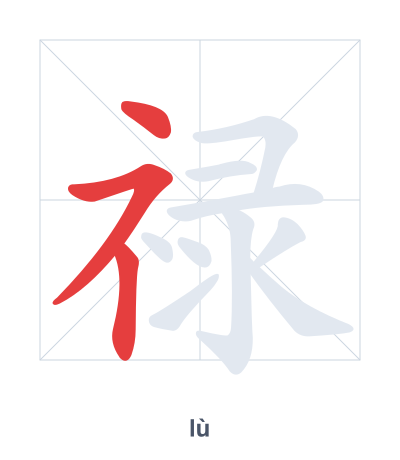
Open Hanzi Writer to see the animated stroke order and practice writing 禄 with real-time feedback.
The character 禄 (lù) is written with 12 strokes. Follow the standard Chinese stroke order: top to bottom, left to right, outside before inside. The radical 礻 is one of its key components.
Practice the correct stroke order with the Hanzi Writer app to see animated stroke-by-stroke guidance with real-time feedback.
禄 means Official's salary; prosperity..
禄 combines the radical 礻 (spirit/altar) with 录 (a record or list), originally symbolizing blessings recorded by the spirits, later evolving to mean an official's salary and prosperity as a heavenly grant.
💡 Memory Tip: Picture an official kneeling before a shrine (礻) as a celestial scroll (录) unfurls to reveal his generous salary, ensuring his prosperity.
祝你福禄双全。
zhù nǐ fú lù shuāng quán
Wish you both happiness and wealth.
古代的官员有俸禄。
gǔ dài de guān yuán yǒu fèng lù
Ancient officials had salaries.
他不追求功名利禄。
tā bù zhuī qiú gōng míng lì lù
He doesn't pursue fame and fortune.
Open Hanzi Writer to see the animated stroke order and practice writing 禄 with real-time feedback.
✨ Animated stroke order · Handwriting recognition · HSK-graded practice · Free to use
禄 is made of the radical 礻 (spirit) on the left and 录 (record) on the right. The radical suggests a connection to blessings or divine rewards, and 录 implies 'list' or 'record', together symbolizing a recorded blessing from heaven — originally meaning official salary or prosperity granted by higher authority.