噜 (lū) means "to grunt or mumble" in Chinese. It has 15 strokes with the radical 口.
Rated 4.2/5 in difficulty (advanced).
Appears in 3+ common words including 呼噜 (hū lū), 嘟噜 (dū lū), 噜噜 (lū lū).
Due to its 15 strokes, Hanzi Writer's error detection shows 噜 requires focused practice — most learners need 10+ attempts for consistent accuracy.
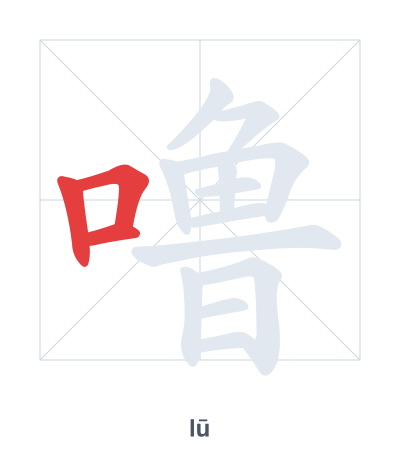
Open Hanzi Writer to see the animated stroke order and practice writing 噜 with real-time feedback.
The character 噜 (lū) is written with 15 strokes. Follow the standard Chinese stroke order: top to bottom, left to right, outside before inside. The radical 口 is one of its key components.
Practice the correct stroke order with the Hanzi Writer app to see animated stroke-by-stroke guidance with real-time feedback.
噜 means to grunt or mumble.
噜 is a phono-semantic compound. The mouth radical (口) indicates it relates to vocal sounds, while 鲁 provides the pronunciation. Together they depict the grumbling sound made by the mouth, like mumbling or grunting.
💡 Memory Tip: Picture a mouth (口) full of fish (鲁) trying to grunt — you hear a muffled 'lū' sound.
他睡觉爱打呼噜。
tā shuì jiào ài dǎ hū lū
He likes to snore when he sleeps.
他嘴里嘟噜着什么。
tā zuǐ lǐ dū lū zhe shén me
He was muttering something under his breath.
小猪噜噜地叫着。
xiǎo zhū lū lū dì jiào zhe
The little pig is oinking.
Open Hanzi Writer to see the animated stroke order and practice writing 噜 with real-time feedback.
✨ Animated stroke order · Handwriting recognition · HSK-graded practice · Free to use
噜 is a left-right character: the left side is 口 (mouth), indicating sounds from the mouth. The right side is 鲁 (lǔ), which gives the approximate pronunciation and hints at a rough or dull sound. Together, they create a character meaning to grunt or mumble.