嘟 (dū) means "(Onomatopoeia) Toot / To pout" in Chinese. It has 13 strokes with the radical 口.
Rated 4.2/5 in difficulty (advanced).
Appears in 3+ common words including 嘟嘟 (dū dū), 嘟嘴 (dū zuǐ), 嘟囔 (dū nāng).
Due to its 13 strokes, Hanzi Writer's error detection shows 嘟 requires focused practice — most learners need 10+ attempts for consistent accuracy.
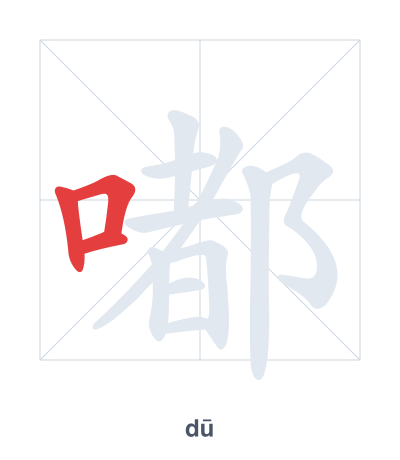
Open Hanzi Writer to see the animated stroke order and practice writing 嘟 with real-time feedback.
The character 嘟 (dū) is written with 13 strokes. Follow the standard Chinese stroke order: top to bottom, left to right, outside before inside. The radical 口 is one of its key components.
Practice the correct stroke order with the Hanzi Writer app to see animated stroke-by-stroke guidance with real-time feedback.
嘟 means (Onomatopoeia) Toot / To pout.
Combines the mouth radical (口) with the phonetic component 都 (dū), indicating a sound produced by the mouth. It is used as an onomatopoeia for the toot of a horn or to describe the action of pouting one's lips.
💡 Memory Tip: Imagine a mouth (口) pouting and making a 'dū' sound, like a car horn honking next to a city (都).
电话嘟嘟地响。
diàn huà dū dū dì xiǎng
The phone is beeping.
妹妹在嘟嘴。
mèi mèi zài dū zuǐ
My younger sister is pouting.
他在小声嘟囔。
tā zài xiǎo shēng dū nāng
He is mumbling.
Open Hanzi Writer to see the animated stroke order and practice writing 嘟 with real-time feedback.
✨ Animated stroke order · Handwriting recognition · HSK-graded practice · Free to use
嘟 is composed of the radical 口 (mouth) on the left, indicating sounds or mouth actions, and the phonetic component 都 (dū) on the right, which gives the pronunciation. The mouth radical connects to both meanings: making a tooting sound with the mouth (onomatopoeia) and the action of pouting (pursing lips).