喽 (lóu) means "final particle (indicating change)" in Chinese. It has 12 strokes with the radical 口.
Rated 4.2/5 in difficulty (advanced).
Appears in 3+ common words including 走喽 (zǒu lóu), 吃饭喽 (chī fàn lóu), 好了喽 (hǎo le lóu).
Due to its 12 strokes, Hanzi Writer's error detection shows 喽 requires focused practice — most learners need 10+ attempts for consistent accuracy.
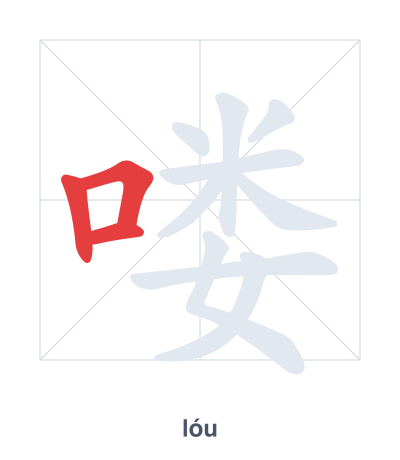
Open Hanzi Writer to see the animated stroke order and practice writing 喽 with real-time feedback.
The character 喽 (lóu) is written with 12 strokes. Follow the standard Chinese stroke order: top to bottom, left to right, outside before inside. The radical 口 is one of its key components.
Practice the correct stroke order with the Hanzi Writer app to see animated stroke-by-stroke guidance with real-time feedback.
喽 means final particle (indicating change).
喽 is a compound character with the radical 口 (mouth, indicating speech) and the phonetic component 娄 (lóu, composed of 米 'rice' over 女 'woman'). It functions as a final particle in spoken Chinese, marking a new situation or change in state.
💡 Memory Tip: Picture a woman (女) dropping her bowl of rice (米) and exclaiming '喽!' from her mouth (口) to announce the sudden change.
我们出发走喽!
wǒ men chū fā zǒu lóu
We're heading out!
大家快来吃饭喽!
dà jiā kuài lái chī fàn lóu
Everyone, come and eat!
事情已经办好了喽。
shì qíng yǐ jīng bàn hǎo le lóu
The matter has been settled.
Open Hanzi Writer to see the animated stroke order and practice writing 喽 with real-time feedback.
✨ Animated stroke order · Handwriting recognition · HSK-graded practice · Free to use
喽 is composed of the mouth radical 口 on the left, which hints at spoken language, and 娄 on the right, which provides the pronunciation. The mouth radical connects to its role as a final particle used in speech to indicate a change or announcement.