懔 (lǐn) means "fearful; awe-stricken" in Chinese. It has 16 strokes with the radical 忄.
Rated 4.2/5 in difficulty (advanced).
Appears in 3+ common words including 懔然 (lǐn rán), 畏懔 (wèi lǐn), 懔冽 (lǐn liè).
Due to its 16 strokes, Hanzi Writer's error detection shows 懔 requires focused practice — most learners need 10+ attempts for consistent accuracy.
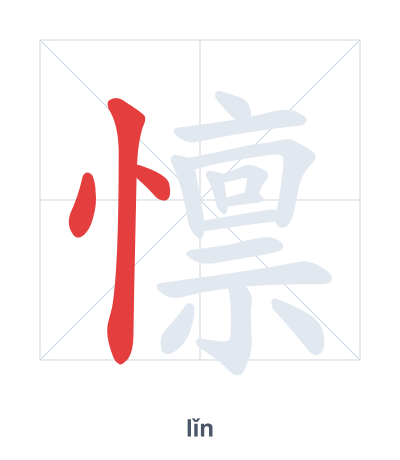
Open Hanzi Writer to see the animated stroke order and practice writing 懔 with real-time feedback.
The character 懔 (lǐn) is written with 16 strokes. Follow the standard Chinese stroke order: top to bottom, left to right, outside before inside. The radical 忄 is one of its key components.
Practice the correct stroke order with the Hanzi Writer app to see animated stroke-by-stroke guidance with real-time feedback.
懔 means fearful; awe-stricken.
懔 combines the heart radical 忄 (mind/emotion) with 禀 (to receive from a superior), suggesting the inner feeling of one who must respectfully receive something awe-inspiring or terrifying. The original meaning was 'to tremble with fear,' as in facing an imposing authority or a solemn ritual.
💡 Memory Tip: Picture a trembling heart (忄) receiving a stern decree (禀) from an emperor — you stand in awe and fear.
他的神色很懔然。
tā de shén sè hěn lǐn rán
His expression is very awe-inspiring.
令人感到畏懔。
lìng rén gǎn dào wèi lǐn
It makes one feel awe-stricken.
寒风懔冽。
hán fēng lǐn liè
The cold wind is piercingly cold.
Open Hanzi Writer to see the animated stroke order and practice writing 懔 with real-time feedback.
✨ Animated stroke order · Handwriting recognition · HSK-graded practice · Free to use
懔 is a left-right structure. The left radical 忄 (heart) suggests emotion or feeling, while the right part 禀 (bǐng) provides the sound and also carries a sense of receiving or being given, together forming the idea of being awe-stricken in the heart.