郦 (lì) means "Li (a surname)" in Chinese. It has 9 strokes with the radical 阝.
Rated 3.7/5 in difficulty (challenging).
Appears in 3+ common words including 郦女士 (lì nǚ shì), 郦老师 (lì lǎo shī), 姓郦 (xìng lì).
Due to its 9 strokes, Hanzi Writer's error detection shows 郦 requires focused practice — most learners need 10+ attempts for consistent accuracy.
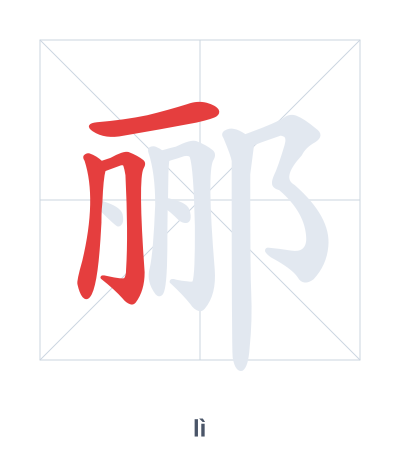
Open Hanzi Writer to see the animated stroke order and practice writing 郦 with real-time feedback.
The character 郦 (lì) is written with 9 strokes. Follow the standard Chinese stroke order: top to bottom, left to right, outside before inside. The radical 阝 is one of its key components.
Practice the correct stroke order with the Hanzi Writer app to see animated stroke-by-stroke guidance with real-time feedback.
郦 means Li (a surname).
郦 is a compound character with the radical 阝 (city mound) on the left and 丽 (beautiful) on the right. It originally referred to an ancient city or fiefdom, and the 丽 component serves as a phonetic hint while also suggesting the beauty of that place. Today it is primarily used as a surname, Li.
💡 Memory Tip: Picture a beautiful city (阝) with ornate gates, and the Li family's mansion (like 丽) stands at its center.
郦女士在喝咖啡。
lì nǚ shì zài hē kā fēi
Ms. Li is drinking coffee.
郦老师教数学。
lì lǎo shī jiào shù xué
Teacher Li teaches math.
她姓郦,不姓李。
tā xìng lì bù xìng lǐ
Her surname is Li (郦), not Li (李).
Open Hanzi Writer to see the animated stroke order and practice writing 郦 with real-time feedback.
✨ Animated stroke order · Handwriting recognition · HSK-graded practice · Free to use
郦 is made of two parts: the left side 丽 (lì) gives the pronunciation, and the right side 阝 (meaning city or town) is the radical. Together they form a surname that originally referred to a place name in ancient China.