棱 (léng) means "Edge or ridge" in Chinese. It has 12 strokes with the radical 木, and is HSK Level 7.
Rated 4.2/5 in difficulty (advanced).
Harder than 64% of HSK Level 7 characters.
Appears in 3+ common words including 棱角 (léng jiǎo), 棱镜 (léng jìng), 模棱两可 (mó léng liǎng kě).
Due to its 12 strokes, Hanzi Writer's error detection shows 棱 requires focused practice — most learners need 10+ attempts for consistent accuracy.
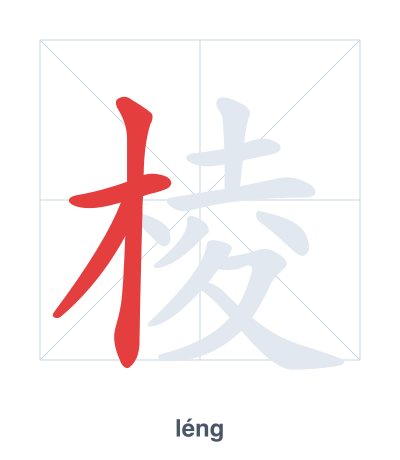
Open Hanzi Writer to see the animated stroke order and practice writing 棱 with real-time feedback.
The character 棱 (léng) is written with 12 strokes. Follow the standard Chinese stroke order: top to bottom, left to right, outside before inside. The radical 木 is one of its key components.
Practice the correct stroke order with the Hanzi Writer app to see animated stroke-by-stroke guidance with real-time feedback.
棱 means Edge or ridge.
As an HSK Level 7 character, 棱 is an intermediate-level character.
The character 棱 combines the radical 木 (wood, tree) with 夌 (líng, 'to climb' or 'mound'). The 夌 component hints at a raised shape, suggesting a wooden object with a protruding edge or ridge, like the corner of a beam or a mountain-like crest on wood.
💡 Memory Tip: Picture a wooden block (木) with a mountain-shaped bump (夌) forming a sharp ridge along its edge.
这里的桌子有棱角。
zhè lǐ de zhuō zi yǒu léng jiǎo
The tables here have sharp edges.
老师在用棱镜做实验。
lǎo shī zài yòng léng jìng zuò shí yàn
The teacher is doing an experiment with a prism.
他的回答模棱两可。
tā de huí dá mó léng liǎng kě
His answer is ambiguous.
Open Hanzi Writer to see the animated stroke order and practice writing 棱 with real-time feedback.
✨ Animated stroke order · Handwriting recognition · HSK-graded practice · Free to use
棱 is a left-right structure: the left part is the radical 木 (wood/tree), and the right part is 夌 (líng, meaning 'to climb' or 'mound'). The wood radical suggests a solid object, while 夌 adds the idea of a raised or angular shape, together forming the concept of a sharp edge or ridge on wood or other materials.