塄 (léng) means "terrace edge / edge of a field" in Chinese. It has 12 strokes with the radical 土.
Rated 4.2/5 in difficulty (advanced).
Appears in 3+ common words including 地塄 (dì léng), 塄坎 (léng kǎn), 土塄 (tǔ léng).
Due to its 12 strokes, Hanzi Writer's error detection shows 塄 requires focused practice — most learners need 10+ attempts for consistent accuracy.
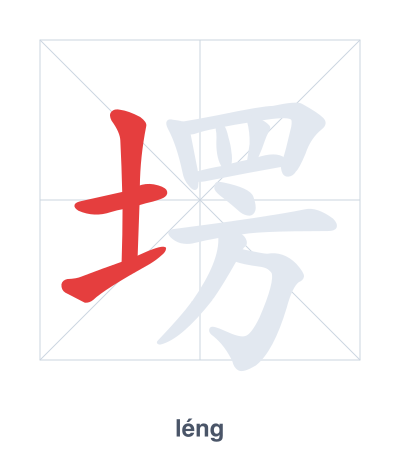
Open Hanzi Writer to see the animated stroke order and practice writing 塄 with real-time feedback.
The character 塄 (léng) is written with 12 strokes. Follow the standard Chinese stroke order: top to bottom, left to right, outside before inside. The radical 土 is one of its key components.
Practice the correct stroke order with the Hanzi Writer app to see animated stroke-by-stroke guidance with real-time feedback.
塄 means terrace edge / edge of a field.
The character 塄 combines the radical 土 (earth, land) with 楞 (léng, meaning 'edge' or 'corner'), which itself suggests a rectangular boundary. Together, they represent the edge of a field or terrace—an earth ridge that marks the border of cultivated land.
💡 Memory Tip: Imagine a field of earth (土) with a rectangular net (罒-like shape) laid flat on its edge, forming a clear boundary line.
他坐在地塄上休息。
tā zuò zài dì léng shàng xiū xī
He is resting on the edge of the field.
小心前面的塄坎。
xiǎo xīn qián miàn de léng kǎn
Watch out for the ridge ahead.
土塄上长满了草。
tǔ léng shàng zhǎng mǎn le cǎo
The earthen ridge is covered with grass.
Open Hanzi Writer to see the animated stroke order and practice writing 塄 with real-time feedback.
✨ Animated stroke order · Handwriting recognition · HSK-graded practice · Free to use
塄 is a left-right structure. The left radical 土 (earth) hints that the character relates to soil or land, while the right component 愣 (léng, meaning 'to stare blankly') gives the pronunciation léng. Together, 塄 describes an edge or ridge made of earth, like the edge of a field.