坎 (kǎn) means "Pit; threshold; ridge." in Chinese. It has 7 strokes with the radical 土.
Rated 3.5/5 in difficulty (challenging).
Appears in 3+ common words including 门坎 (mén kǎn), 坎坷 (kǎn kě), 坎儿 (kǎn ér).
Due to its 7 strokes, Hanzi Writer's error detection shows 坎 requires focused practice — most learners need 10+ attempts for consistent accuracy.
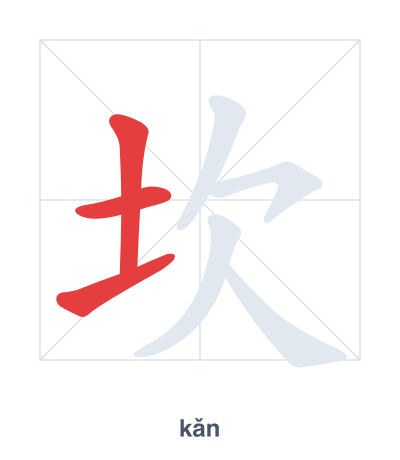
Open Hanzi Writer to see the animated stroke order and practice writing 坎 with real-time feedback.
The character 坎 (kǎn) is written with 7 strokes. Follow the standard Chinese stroke order: top to bottom, left to right, outside before inside. The radical 土 is one of its key components.
Practice the correct stroke order with the Hanzi Writer app to see animated stroke-by-stroke guidance with real-time feedback.
坎 means Pit; threshold; ridge..
坎 combines the earth radical 土 (soil) with 欠 (a person yawning/open mouth), suggesting a hollow or gap in the ground—a pit or depression.
💡 Memory Tip: Picture a person (欠) tumbling into a hole in the earth (土), yelling 'Kǎn!' as they hit the bottom.
别踩那个门坎。
bié cǎi nà ge mén kǎn
Don't step on the threshold.
他的生活很坎坷。
tā de shēng huó hěn kǎn kě
His life has been full of ups and downs.
这是一个小坎儿。
zhè shì yí gè xiǎo kǎn ér
This is a small hurdle or obstacle.
Open Hanzi Writer to see the animated stroke order and practice writing 坎 with real-time feedback.
✨ Animated stroke order · Handwriting recognition · HSK-graded practice · Free to use
坎 is made of 土 (earth) on the left and 欠 (owe or lack) on the right. This structure suggests a pit or hollow in the earth, which connects to its meanings of a pit, a threshold ridge, or a bumpy surface. The idea of lacking (欠) earth (土) visually implies a depression or obstacle in the ground.