嘞 (lei) means "(Particle) Indicating completion or calling for attention" in Chinese. It has 14 strokes with the radical 口.
Rated 4.2/5 in difficulty (advanced).
Appears in 3+ common words including 好嘞 (hǎo lei), 走嘞 (zǒu lei), 行嘞 (xíng lei).
Due to its 14 strokes, Hanzi Writer's error detection shows 嘞 requires focused practice — most learners need 10+ attempts for consistent accuracy.
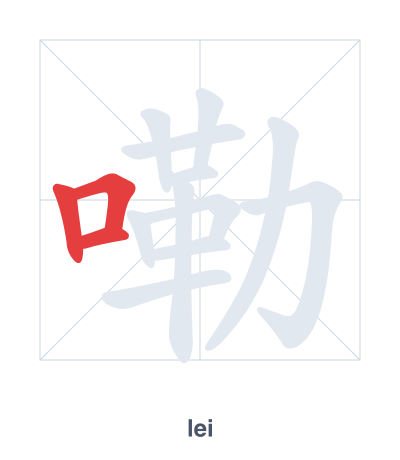
Open Hanzi Writer to see the animated stroke order and practice writing 嘞 with real-time feedback.
The character 嘞 (lei) is written with 14 strokes. Follow the standard Chinese stroke order: top to bottom, left to right, outside before inside. The radical 口 is one of its key components.
Practice the correct stroke order with the Hanzi Writer app to see animated stroke-by-stroke guidance with real-time feedback.
嘞 means (Particle) Indicating completion or calling for attention.
This character combines the mouth radical (口) indicating speech or utterance, with 勒 (lè, 'to rein in') as a phonetic component. It functions as a colloquial particle marking completion of an action or calling attention, similar to '了' or '啦'.
💡 Memory Tip: Picture a mouth (口) pulling a leash (勒) to yank someone's attention, shouting '嘞!' as if to say 'Hey, I'm done here!'
好嘞,我马上就去。
hǎo lei wǒ mǎ shàng jiù qù
Sure thing, I'll go right away.
我们走嘞!
wǒ men zǒu lei
We're leaving!
行嘞,没问题。
xíng lei méi wèn tí
Alright, no problem.
Open Hanzi Writer to see the animated stroke order and practice writing 嘞 with real-time feedback.
✨ Animated stroke order · Handwriting recognition · HSK-graded practice · Free to use
嘞 is a phono-semantic compound. The left radical 口 (mouth) indicates that it is a spoken particle, while the right part 勒 (lè, meaning to restrain) provides the pronunciation lēi. Together, the character represents a verbal exclamation used to signal completion or get attention.