栏 (lán) means "fence; railing; column" in Chinese. It has 9 strokes with the radical 木, and is HSK Level 6.
Rated 4/5 in difficulty (challenging).
Harder than 48% of HSK Level 6 characters.
Appears in 3+ common words including 栏杆 (lán gān), 专栏 (zhuān lán), 围栏 (wéi lán).
Due to its 9 strokes, Hanzi Writer's error detection shows 栏 requires focused practice — most learners need 10+ attempts for consistent accuracy.
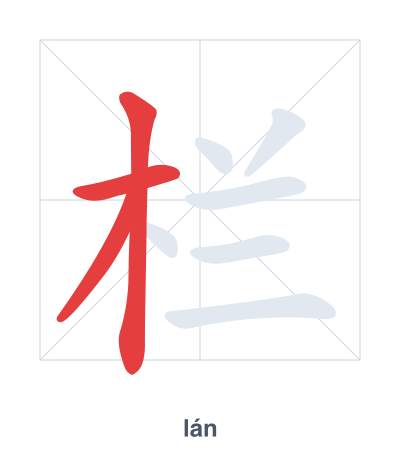
Open Hanzi Writer to see the animated stroke order and practice writing 栏 with real-time feedback.
The character 栏 (lán) is written with 9 strokes. Follow the standard Chinese stroke order: top to bottom, left to right, outside before inside. The radical 木 is one of its key components.
Practice the correct stroke order with the Hanzi Writer app to see animated stroke-by-stroke guidance with real-time feedback.
栏 means fence; railing; column.
As an HSK Level 6 character, 栏 is an intermediate-level character.
栏 is a compound character combining the radical 木 (wood, indicating material) with the phonetic component 兰 (lán, originally meaning orchid but here solely for sound). Wood was the primary material for fences and railings in ancient times, so the shape directly links to the meaning of a wooden barrier or column.
💡 Memory Tip: Imagine a wooden fence (木) with a potted orchid (兰) sitting on top, marking each column.
请不要靠着栏杆。
qǐng bú yào kào zhe lán gān
Please don't lean against the railing.
我喜欢看这个专栏。
wǒ xǐ huān kàn zhè ge zhuān lán
I like reading this column.
花园外面有木围栏。
huā yuán wài miàn yǒu mù wéi lán
There is a wooden fence outside the garden.
Open Hanzi Writer to see the animated stroke order and practice writing 栏 with real-time feedback.
✨ Animated stroke order · Handwriting recognition · HSK-graded practice · Free to use
栏 is composed of the radical 木 (wood/tree) on the left, and the phonetic component 兰 (lán, orchid) on the right. The 木 indicates that fences and railings were traditionally made of wood, while 兰 provides the sound. So the character combines a concrete material (wood) with a sound hint to form a word meaning 'fence' or 'railing'.