窾 (kuǎn) means "hollow / empty / gap" in Chinese. It has 17 strokes with the radical 穴.
Rated 4.2/5 in difficulty (advanced).
Appears in 3+ common words including 窾窍 (kuǎn qiào), 窾坎 (kuǎn kǎn), 窾言 (kuǎn yán).
Due to its 17 strokes, Hanzi Writer's error detection shows 窾 requires focused practice — most learners need 10+ attempts for consistent accuracy.
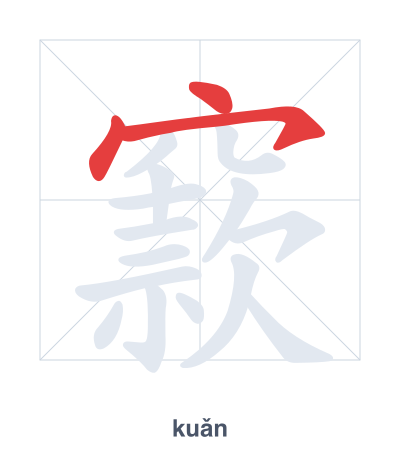
Open Hanzi Writer to see the animated stroke order and practice writing 窾 with real-time feedback.
The character 窾 (kuǎn) is written with 17 strokes. Follow the standard Chinese stroke order: top to bottom, left to right, outside before inside. The radical 穴 is one of its key components.
Practice the correct stroke order with the Hanzi Writer app to see animated stroke-by-stroke guidance with real-time feedback.
窾 means hollow / empty / gap.
窾 is a phono-semantic compound: the radical 穴 (cave/hole) conveys the meaning of a hollow space, while the component 款 (kuǎn) provides the pronunciation. Together they depict a cavity or gap, like an empty recess in a cave.
💡 Memory Tip: Picture a cave (穴) with a large, hollow opening shaped like a wide-open mouth (款's 欠 component suggests a yawn), leaving an empty gap inside.
他终于找到了问题的窾窍。
tā zhōng yú zhǎo dào le wèn tí de kuǎn qiào
He finally found the key to the problem.
水流击石,发出窾坎声。
shuǐ liú jī shí fā chū kuǎn kǎn shēng
The water hits the rocks, making a hollow clanging sound.
他的话多是窾言。
tā de huà duō shì kuǎn yán
His words are mostly empty talk.
Open Hanzi Writer to see the animated stroke order and practice writing 窾 with real-time feedback.
✨ Animated stroke order · Handwriting recognition · HSK-graded practice · Free to use
窾 is composed of the radical 穴 (cave) on top and the phonetic component 款 (kuǎn) below. The cave radical relates to the meaning of 'hollow' or 'empty space', while 款 provides the pronunciation. This structure visually represents a hollow cavity or gap.