喾 (kù) means "Emperor Ku (mythical)" in Chinese. It has 12 strokes with the radical 口.
Rated 3.9/5 in difficulty (challenging).
Appears in 3+ common words including 帝喾 (dì kù), 喾庙 (kù miào), 喾陵 (kù líng).
Due to its 12 strokes, Hanzi Writer's error detection shows 喾 requires focused practice — most learners need 10+ attempts for consistent accuracy.
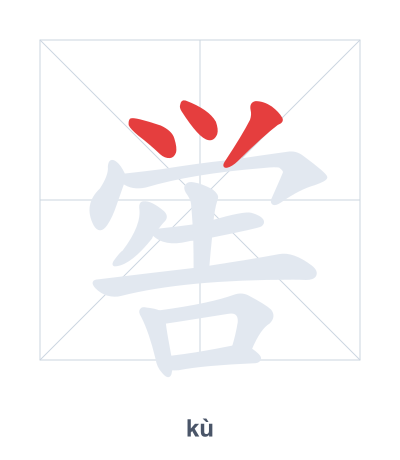
Open Hanzi Writer to see the animated stroke order and practice writing 喾 with real-time feedback.
The character 喾 (kù) is written with 12 strokes. Follow the standard Chinese stroke order: top to bottom, left to right, outside before inside. The radical 口 is one of its key components.
Practice the correct stroke order with the Hanzi Writer app to see animated stroke-by-stroke guidance with real-time feedback.
喾 means Emperor Ku (mythical).
喾 is a compound character formed with 告 (to announce/report) above 口 (mouth), suggesting an act of speaking or proclamation. This phonetic component links to the legendary Emperor Ku, a mythical ruler in ancient Chinese lore known for his wise edicts and communication with the divine.
💡 Memory Tip: Picture Emperor Ku standing on a high platform, his crowned head (告) hovering over a giant mouth (口) as he delivers a thunderous decree to the people.
帝喾是古代的皇帝。
dì kù shì gǔ dài de huáng dì
Emperor Ku was an ancient emperor.
这里有一座帝喾庙。
zhè lǐ yǒu yī zuò dì kù miào
There is a temple of Emperor Ku here.
我们去参观了喾陵。
wǒ men qù cān guān le kù líng
We went to visit the Mausoleum of Emperor Ku.
Open Hanzi Writer to see the animated stroke order and practice writing 喾 with real-time feedback.
✨ Animated stroke order · Handwriting recognition · HSK-graded practice · Free to use
The character 喾 is composed of a top part shaped like a container (凵) and a bottom part that is the radical 口 (mouth). This structure does not directly reveal its meaning, as 喾 is a proper name for the mythical Emperor Ku. The radical 口 is common in many characters and here simply serves as a phonetic or structural element.