勘 (kān) means "to investigate; to survey; to check" in Chinese. It has 11 strokes with the radical 力, and is HSK Level 7.
Rated 3.9/5 in difficulty (challenging).
Harder than 35% of HSK Level 7 characters.
Appears in 3+ common words including 勘察 (kān chá), 勘探 (kān tàn), 勘误 (kān wù).
Due to its 11 strokes, Hanzi Writer's error detection shows 勘 requires focused practice — most learners need 10+ attempts for consistent accuracy.
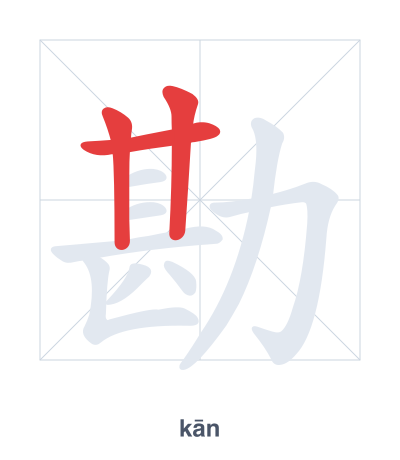
Open Hanzi Writer to see the animated stroke order and practice writing 勘 with real-time feedback.
The character 勘 (kān) is written with 11 strokes. Follow the standard Chinese stroke order: top to bottom, left to right, outside before inside. The radical 力 is one of its key components.
Practice the correct stroke order with the Hanzi Writer app to see animated stroke-by-stroke guidance with real-time feedback.
勘 means to investigate; to survey; to check.
As an HSK Level 7 character, 勘 is an intermediate-level character.
勘 combines the radical 力 (strength/effort) with 甚 (deep/extreme), suggesting using great effort to investigate or survey something thoroughly.
💡 Memory Tip: Imagine a surveyor using all his strength (力) to dig deep (甚) into the ground to check the soil.
专家在现场勘察。
zhuān jiā zài xiàn chǎng kān chá
Experts are conducting an on-site investigation.
他们在勘探石油。
tā men zài kān tàn shí yóu
They are prospecting for oil.
这本书需要勘误。
zhè běn shū xū yào kān wù
This book needs corrections.
Open Hanzi Writer to see the animated stroke order and practice writing 勘 with real-time feedback.
✨ Animated stroke order · Handwriting recognition · HSK-graded practice · Free to use
勘 combines the left component 甚 (which provides the sound kān) and the right radical 力 (power or strength). Together they suggest using strength or effort to investigate or survey something thoroughly.