勈 (yǒng) means "Brave" in Chinese. It has 9 strokes with the radical 力.
Rated 3.7/5 in difficulty (challenging).
Appears in 3+ common words including 勈力 (yǒng lì), 勈夫 (yǒng fū), 勈健 (yǒng jiàn).
Due to its 9 strokes, Hanzi Writer's error detection shows 勈 requires focused practice — most learners need 10+ attempts for consistent accuracy.
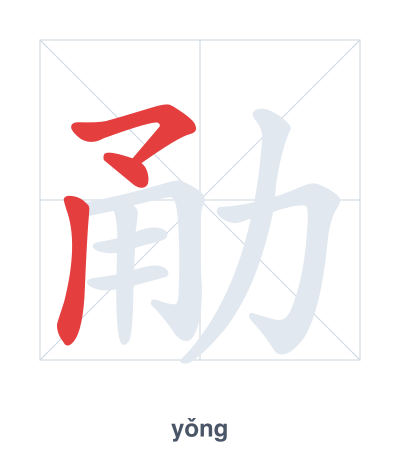
Open Hanzi Writer to see the animated stroke order and practice writing 勈 with real-time feedback.
The character 勈 (yǒng) is written with 9 strokes. Follow the standard Chinese stroke order: top to bottom, left to right, outside before inside. The radical 力 is one of its key components.
Practice the correct stroke order with the Hanzi Writer app to see animated stroke-by-stroke guidance with real-time feedback.
勈 means Brave.
勈 is a phono-semantic compound combining the radical 力 (strength) with the phonetic component 甬 (yǒng, originally meaning a tunnel or passage). The 力 radical conveys that bravery involves physical or inner strength, while 甬 indicates the pronunciation and may suggest the idea of pressing forward through obstacles.
💡 Memory Tip: Picture a brave warrior using all his strength (力) to burst through a blocked tunnel (甬), charging fearlessly ahead.
他在勈力工作。
tā zài yǒng lì gōng zuò
He is working with great effort.
他是一个勈夫。
tā shì yí gè yǒng fū
He is a brave man.
他的身体很勈健。
tā de shēn tǐ hěn yǒng jiàn
His body is very strong and brave.
Open Hanzi Writer to see the animated stroke order and practice writing 勈 with real-time feedback.
✨ Animated stroke order · Handwriting recognition · HSK-graded practice · Free to use
勈 is composed of 力 (lì, strength/power) on the right and 甬 (yǒng) on the left. 甬 is a phonetic component suggesting the pronunciation yǒng, while 力 indicates that the meaning involves strength or force. Together they form the concept of 'brave' as a kind of courageous strength.