蹶 (jué) means "to stumble; to kick (of a horse)" in Chinese. It has 19 strokes with the radical 足.
Rated 4.2/5 in difficulty (advanced).
Appears in 3+ common words including 一蹶不振 (yī jué bù zhèn), 蹶倒 (jué dào), 蹶子 (jué zi).
Due to its 19 strokes, Hanzi Writer's error detection shows 蹶 requires focused practice — most learners need 10+ attempts for consistent accuracy.
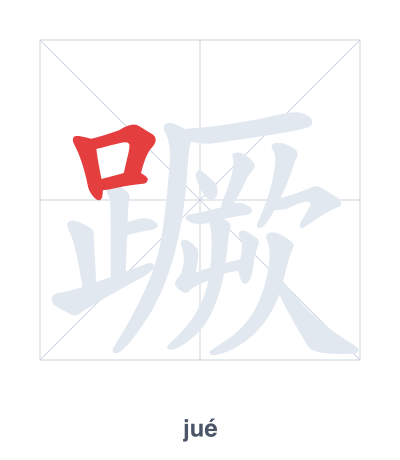
Open Hanzi Writer to see the animated stroke order and practice writing 蹶 with real-time feedback.
The character 蹶 (jué) is written with 19 strokes. Follow the standard Chinese stroke order: top to bottom, left to right, outside before inside. The radical 足 is one of its key components.
Practice the correct stroke order with the Hanzi Writer app to see animated stroke-by-stroke guidance with real-time feedback.
蹶 means to stumble; to kick (of a horse).
蹶 combines the foot radical 足 (showing action) with 厥, which originally depicted a stone drill or tool; the idea is a foot striking a hard object, causing a stumble or kick.
💡 Memory Tip: Picture a horse kicking back with its foot (足) as if it stumbled over a stone drill (厥) buried in the ground.
他失败后并没有一蹶不振。
tā shī bài hòu bìng méi yǒu yī jué bù zhèn
He didn't give up after his failure.
他不小心在冰上蹶倒了。
tā bù xiǎo xīn zài bīng shàng jué dào le
He accidentally slipped and fell on the ice.
那匹马踢了一个蹶子。
nà pǐ mǎ tī le yí gè jué zi
That horse kicked its heels.
Open Hanzi Writer to see the animated stroke order and practice writing 蹶 with real-time feedback.
✨ Animated stroke order · Handwriting recognition · HSK-graded practice · Free to use
The left side is 足 (foot), showing the character relates to foot actions. The right side 厥 (jué) provides the sound and originally meant 'to collapse.' Together, they describe stumbling with the foot or a horse's kicking motion.