撅 (juē) means "to break (something long and thin); to stick out; to pout" in Chinese. It has 15 strokes with the radical 扌.
Rated 4.2/5 in difficulty (advanced).
Appears in 3+ common words including 撅嘴 (juē zuǐ), 撅断 (juē duàn), 撅着 (juē zhe).
Due to its 15 strokes, Hanzi Writer's error detection shows 撅 requires focused practice — most learners need 10+ attempts for consistent accuracy.
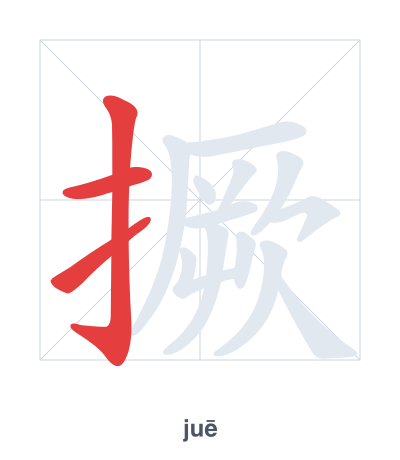
Open Hanzi Writer to see the animated stroke order and practice writing 撅 with real-time feedback.
The character 撅 (juē) is written with 15 strokes. Follow the standard Chinese stroke order: top to bottom, left to right, outside before inside. The radical 扌 is one of its key components.
Practice the correct stroke order with the Hanzi Writer app to see animated stroke-by-stroke guidance with real-time feedback.
撅 means to break (something long and thin); to stick out; to pout.
撅 combines the hand radical 扌 with 厥, which depicts a person digging under a cliff (厂) and originally meant 'to break off' or 'to dig out'. Together, they show a hand breaking something long and thin, or forcing something to stick out like a pout.
💡 Memory Tip: Picture a hand (扌) breaking a long twig under a cliff (厥), causing the broken end to stick out like a pouting lip.
妹妹在撅嘴。
mèi mèi zài juē zuǐ
My younger sister is pouting.
他把木棍撅断了。
tā bǎ mù gùn juē duàn le
He snapped the wooden stick.
他撅着屁股找书。
tā juē zhe pì gǔ zhǎo shū
He stuck his bottom up while looking for a book.
Open Hanzi Writer to see the animated stroke order and practice writing 撅 with real-time feedback.
✨ Animated stroke order · Handwriting recognition · HSK-graded practice · Free to use
The character 撅 has the radical 扌 on the left, which indicates a hand action, and the right part 厥 (jué) gives the pronunciation. The hand radical connects to the meanings of breaking something with your hands or sticking out your lips (pouting). The right part also hints at the idea of something protruding or being snapped off.