鹃 (juān) means "Cuckoo" in Chinese. It has 12 strokes with the radical 鸟.
Rated 4.2/5 in difficulty (advanced).
Appears in 3+ common words including 杜鹃 (dù juān), 杜鹃鸟 (dù juān niǎo), 鹃啼 (juān tí).
Due to its 12 strokes, Hanzi Writer's error detection shows 鹃 requires focused practice — most learners need 10+ attempts for consistent accuracy.
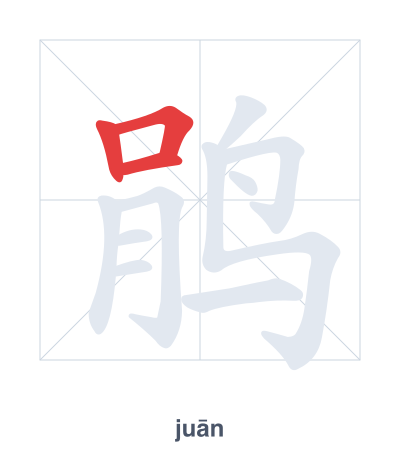
Open Hanzi Writer to see the animated stroke order and practice writing 鹃 with real-time feedback.
The character 鹃 (juān) is written with 12 strokes. Follow the standard Chinese stroke order: top to bottom, left to right, outside before inside. The radical 鸟 is one of its key components.
Practice the correct stroke order with the Hanzi Writer app to see animated stroke-by-stroke guidance with real-time feedback.
鹃 means Cuckoo.
This character is a phono-semantic compound. The left side 肙 (yuān) provides the sound (juān), while the right side 鸟 (bird) indicates the meaning of a bird. Together they denote the cuckoo bird.
💡 Memory Tip: Picture the cuckoo (鸟) singing 'juān-juān' while its beak curves like the wriggly shape of 肙.
杜鹃花开了。
dù juān huā kāi le
The azaleas are in bloom.
杜鹃鸟在叫。
dù juān niǎo zài jiào
The cuckoo is calling.
杜鹃声声啼。
dù juān shēng shēng tí
The cuckoo chirps repeatedly.
Open Hanzi Writer to see the animated stroke order and practice writing 鹃 with real-time feedback.
✨ Animated stroke order · Handwriting recognition · HSK-graded practice · Free to use
鹃 is a left-right character. The left part 肙 (yuān) provides a pronunciation hint, and the right part 鸟 (bird radical) indicates that the character refers to a type of bird. Together they represent the cuckoo bird.