锯 (jù) means "saw; to saw" in Chinese. It has 13 strokes with the radical 钅, and is HSK Level 7.
Rated 4.2/5 in difficulty (advanced).
Harder than 95% of HSK Level 7 characters.
Appears in 3+ common words including 锯子 (jù zi), 电锯 (diàn jù), 锯木头 (jù mù tou).
Due to its 13 strokes, Hanzi Writer's error detection shows 锯 requires focused practice — most learners need 10+ attempts for consistent accuracy.
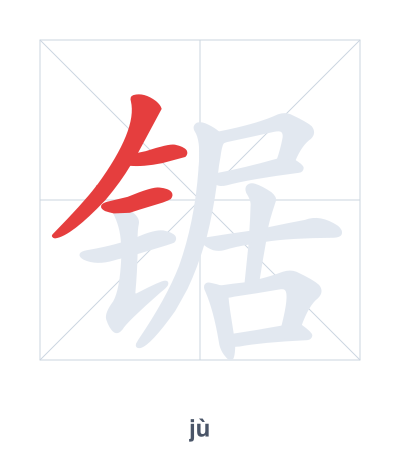
Open Hanzi Writer to see the animated stroke order and practice writing 锯 with real-time feedback.
The character 锯 (jù) is written with 13 strokes. Follow the standard Chinese stroke order: top to bottom, left to right, outside before inside. The radical 钅 is one of its key components.
Practice the correct stroke order with the Hanzi Writer app to see animated stroke-by-stroke guidance with real-time feedback.
锯 means saw; to saw.
As an HSK Level 7 character, 锯 is an intermediate-level character.
锯 is a phono-semantic compound: the radical 钅 (metal) indicates the tool's material, while the component 居 (jū) provides the sound. The original meaning is a saw, a metal cutting tool with teeth.
💡 Memory Tip: Picture a metal (钅) blade that 'dwells' (居) inside a log, moving back and forth to saw it in half.
我买了一把锯子。
wǒ mǎi le yī bǎ jù zi
I bought a saw.
电锯的声音很大。
diàn jù de shēng yīn hěn dà
The electric saw is very loud.
他在外面锯木头。
tā zài wài miàn jù mù tou
He is sawing wood outside.
Open Hanzi Writer to see the animated stroke order and practice writing 锯 with real-time feedback.
✨ Animated stroke order · Handwriting recognition · HSK-graded practice · Free to use
锯 is a phono-semantic compound. The left radical 钅 (jīn) means "metal" or "gold," indicating the character relates to a metal tool. The right side 居 (jū) provides the pronunciation and originally meant "to reside," but here it mainly serves as a phonetic component.