铐 (kào) means "Handcuffs / To handcuff" in Chinese. It has 11 strokes with the radical 钅.
Rated 4.2/5 in difficulty (advanced).
Appears in 3+ common words including 手铐 (shǒu kào), 铐住 (kào zhù), 脚铐 (jiǎo kào).
Due to its 11 strokes, Hanzi Writer's error detection shows 铐 requires focused practice — most learners need 10+ attempts for consistent accuracy.
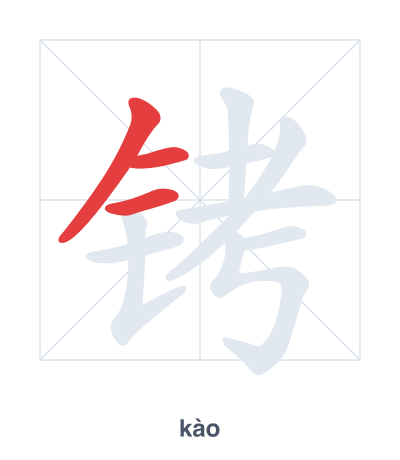
Open Hanzi Writer to see the animated stroke order and practice writing 铐 with real-time feedback.
The character 铐 (kào) is written with 11 strokes. Follow the standard Chinese stroke order: top to bottom, left to right, outside before inside. The radical 钅 is one of its key components.
Practice the correct stroke order with the Hanzi Writer app to see animated stroke-by-stroke guidance with real-time feedback.
铐 means Handcuffs / To handcuff.
铐 is a semantic-phonetic compound. The radical 钅 (metal) indicates the material, while 考 (kǎo) provides the sound. The character refers to metal restraints for the wrists, like handcuffs.
💡 Memory Tip: Imagine a metal (钅) cuff shaped like the letter 'C' that clamps onto a clock (考) to arrest time itself.
警察拿出了手铐。
jǐng chá ná chū le shǒu kào
The police took out the handcuffs.
他的手被铐住了。
tā de shǒu bèi kào zhù le
His hands were handcuffed.
他戴着脚铐。
tā dài zhe jiǎo kào
He is wearing leg shackles.
Open Hanzi Writer to see the animated stroke order and practice writing 铐 with real-time feedback.
✨ Animated stroke order · Handwriting recognition · HSK-graded practice · Free to use
The left side is the radical 钅 (jīn), meaning 'metal' or 'gold', which indicates handcuffs are usually made of metal. The right side is 考 (kǎo), which provides the pronunciation 'kào' but also suggests the idea of 'testing' or 'restraining'. Together, the character depicts a metal device used to restrain someone, like handcuffs.