掬 (jū) means "to scoop up with both hands" in Chinese. It has 11 strokes with the radical 扌.
Rated 4.2/5 in difficulty (advanced).
Appears in 3+ common words including 笑容可掬 (xiào róng kě jū), 憨态可掬 (hān tài kě jū), 掬起 (jū qǐ).
Due to its 11 strokes, Hanzi Writer's error detection shows 掬 requires focused practice — most learners need 10+ attempts for consistent accuracy.
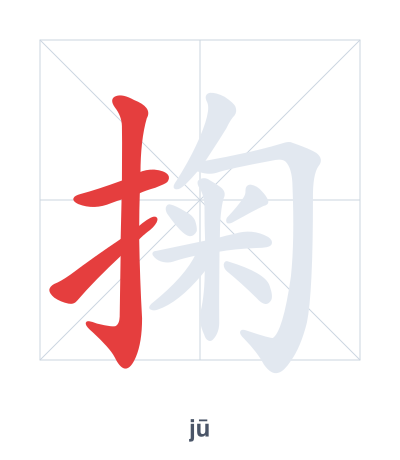
Open Hanzi Writer to see the animated stroke order and practice writing 掬 with real-time feedback.
The character 掬 (jū) is written with 11 strokes. Follow the standard Chinese stroke order: top to bottom, left to right, outside before inside. The radical 扌 is one of its key components.
Practice the correct stroke order with the Hanzi Writer app to see animated stroke-by-stroke guidance with real-time feedback.
掬 means to scoop up with both hands.
The character 掬 combines the hand radical 扌 (hand) with the phonetic component 匊 (jū), which originally depicted a hand grasping or cupping something, reinforcing the meaning of scooping up with both hands. The left side shows the action of the hand, while the right side hints at the cupped shape of the hands.
💡 Memory Tip: Picture two hands (扌) forming a bowl to catch a round ball (the 匊 part looks like a ball inside curved hands) as you scoop it up.
老师笑容可掬。
lǎo shī xiào róng kě jū
The teacher has a beaming smile.
熊猫憨态可掬。
xióng māo hān tài kě jū
Pandas are charmingly cute.
他掬起一捧水。
tā jū qǐ yī pěng shuǐ
He scooped up a handful of water.
Open Hanzi Writer to see the animated stroke order and practice writing 掬 with real-time feedback.
✨ Animated stroke order · Handwriting recognition · HSK-graded practice · Free to use
掬 combines the radical 扌 (hand) on the left with 匊 (jū) on the right. 扌 shows that the action involves the hands, while 匊 originally depicted holding grain, reinforcing the idea of scooping up with both hands. Together they create the meaning of lifting or cupping something in your palms.