憨 (hān) means "simple-minded" in Chinese. It has 15 strokes with the radical 心.
Rated 4.2/5 in difficulty (advanced).
Appears in 3+ common words including 憨厚 (hān hòu), 憨笑 (hān xiào), 憨态可掬 (hān tài kě jū).
Due to its 15 strokes, Hanzi Writer's error detection shows 憨 requires focused practice — most learners need 10+ attempts for consistent accuracy.
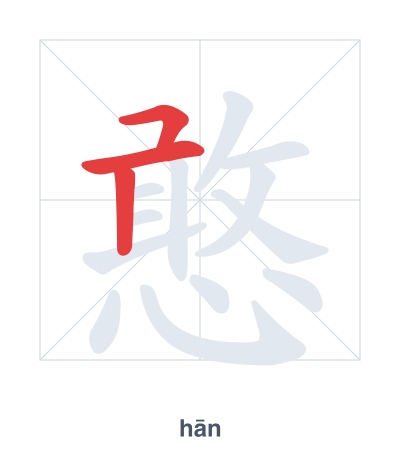
Open Hanzi Writer to see the animated stroke order and practice writing 憨 with real-time feedback.
The character 憨 (hān) is written with 15 strokes. Follow the standard Chinese stroke order: top to bottom, left to right, outside before inside. The radical 心 is one of its key components.
Practice the correct stroke order with the Hanzi Writer app to see animated stroke-by-stroke guidance with real-time feedback.
憨 means simple-minded.
憨 combines the heart radical 心 (mind) with 敢 (bold, daring) as a phonetic component, suggesting a simple-minded person whose heart acts boldly without cunning.
💡 Memory Tip: Picture a bold heart (敢 above 心) that is so naive it happily charges into a trap without a second thought.
他长得很憨厚。
tā zhǎng dé hěn hān hòu
He looks simple and honest.
他对着我憨笑。
tā duì zhe wǒ hān xiào
He smiled naively at me.
熊猫的样子憨态可掬。
xióng māo de yàng zi hān tài kě jū
The panda looks charmingly cute.
Open Hanzi Writer to see the animated stroke order and practice writing 憨 with real-time feedback.
✨ Animated stroke order · Handwriting recognition · HSK-graded practice · Free to use
憨 is made of two parts: the top part 敢 (gǎn, meaning daring) and the bottom part 心 (heart). It suggests a person with a 'daring heart' who acts without thinking too much, which connects to the meaning of being simple-minded or naive.