兽 (shòu) means "beast; animal" in Chinese. It has 11 strokes with the radical 丷, and is HSK Level 7.
Rated 3.9/5 in difficulty (challenging).
Harder than 34% of HSK Level 7 characters.
Appears in 3+ common words including 野兽 (yě shòu), 怪兽 (guài shòu), 兽医 (shòu yī).
Due to its 11 strokes, Hanzi Writer's error detection shows 兽 requires focused practice — most learners need 10+ attempts for consistent accuracy.
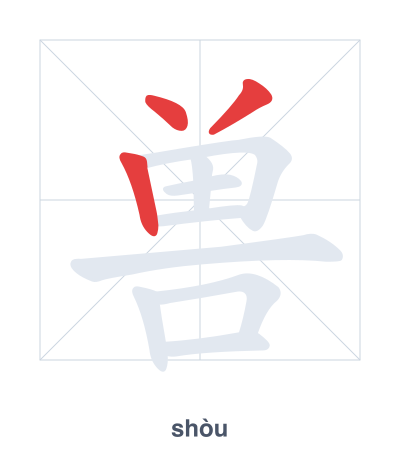
Open Hanzi Writer to see the animated stroke order and practice writing 兽 with real-time feedback.
The character 兽 (shòu) is written with 11 strokes. Follow the standard Chinese stroke order: top to bottom, left to right, outside before inside. The radical 丷 is one of its key components.
Practice the correct stroke order with the Hanzi Writer app to see animated stroke-by-stroke guidance with real-time feedback.
兽 means beast; animal.
As an HSK Level 7 character, 兽 is an intermediate-level character.
Originally, 兽 depicted a hunting scene with a net (田) and a dog (犬), meaning 'to hunt'. It later came to represent the animal being hunted, a beast. The modern simplified form retains a stylized net (田) and a bottom part resembling an animal's open mouth (口).
💡 Memory Tip: Picture a beast with two horns (丷) standing in a field (田) and opening its mouth (口) wide to roar.
森林里有很多野兽。
sēn lín lǐ yǒu hěn duō yě shòu
There are many wild beasts in the forest.
电影里有一个大怪兽。
diàn yǐng lǐ yǒu yí gè dà guài shòu
There is a big monster in the movie.
他是一名专业的兽医。
tā shì yī míng zhuān yè de shòu yī
He is a professional veterinarian.
Open Hanzi Writer to see the animated stroke order and practice writing 兽 with real-time feedback.
✨ Animated stroke order · Handwriting recognition · HSK-graded practice · Free to use
兽 consists of three parts: top 丷 (like two dots or horns), middle 口 (mouth), and bottom 田 (field). This structure suggests a beast with horns and a mouth standing in a field, relating to its meaning of wild animal.