猥 (wěi) means "obscene; vulgar" in Chinese. It has 12 strokes with the radical 犭.
Rated 4.2/5 in difficulty (advanced).
Appears in 3+ common words including 猥琐 (wěi suǒ), 猥亵 (wěi xiè), 卑猥 (bēi wěi).
Due to its 12 strokes, Hanzi Writer's error detection shows 猥 requires focused practice — most learners need 10+ attempts for consistent accuracy.
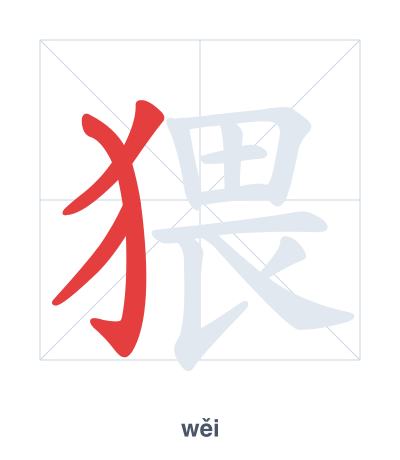
Open Hanzi Writer to see the animated stroke order and practice writing 猥 with real-time feedback.
The character 猥 (wěi) is written with 12 strokes. Follow the standard Chinese stroke order: top to bottom, left to right, outside before inside. The radical 犭 is one of its key components.
Practice the correct stroke order with the Hanzi Writer app to see animated stroke-by-stroke guidance with real-time feedback.
猥 means obscene; vulgar.
This compound character combines the radical 犭 (dog or beast) with 畏 (wěi, meaning fear or awe). Originally it described the sound of dogs barking, but over time it evolved to mean lowly, vulgar, or obscene behavior—like a beast's shameless noise.
💡 Memory Tip: Picture a nasty dog (犭) that barks so rudely and vilely that everyone fears (畏) its obscene mouth.
那个人的样子很猥琐。
nà ge rén de yàng zi hěn wěi suǒ
That person looks wretched and sleazy.
这种行为属于猥亵。
zhè zhǒng xíng wéi shǔ yú wěi xiè
This behavior constitutes indecency.
他的言语非常卑猥。
tā de yán yǔ fēi cháng bēi wěi
His language is very vulgar.
Open Hanzi Writer to see the animated stroke order and practice writing 猥 with real-time feedback.
✨ Animated stroke order · Handwriting recognition · HSK-graded practice · Free to use
猥 combines the radical 犭 (animal or beast) with the component 畏 (wèi, fear). The animal radical suggests base or crude behavior, while 畏 hints at something that causes fear or disgust. Together, they create the idea of something beastly and repulsive, which connects to the meanings "obscene" and "vulgar."