谏 (jiàn) means "to admonish a superior" in Chinese. It has 11 strokes with the radical 讠.
Rated 3.9/5 in difficulty (challenging).
Appears in 3+ common words including 谏言 (jiàn yán), 劝谏 (quàn jiàn), 直谏 (zhí jiàn).
Due to its 11 strokes, Hanzi Writer's error detection shows 谏 requires focused practice — most learners need 10+ attempts for consistent accuracy.
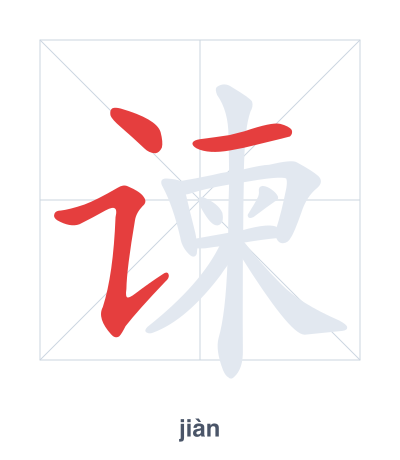
Open Hanzi Writer to see the animated stroke order and practice writing 谏 with real-time feedback.
The character 谏 (jiàn) is written with 11 strokes. Follow the standard Chinese stroke order: top to bottom, left to right, outside before inside. The radical 讠 is one of its key components.
Practice the correct stroke order with the Hanzi Writer app to see animated stroke-by-stroke guidance with real-time feedback.
谏 means to admonish a superior.
The character 谏 combines the speech radical 讠 (言) with 柬, which originally depicted a bundle of slips or a letter. Together, they convey the act of speaking or presenting a written admonition to a superior, as if offering a formal remonstrance in court.
💡 Memory Tip: Imagine a minister (讠) presenting a bundled scroll (柬) to the emperor, boldly speaking truth to power to admonish him.
他给经理提了谏言。
tā gěi jīng lǐ tí le jiàn yán
He gave the manager some advice.
朋友在劝谏他。
péng yǒu zài quàn jiàn tā
A friend is advising him.
他敢于向老板直谏。
tā gǎn yú xiàng lǎo bǎn zhí jiàn
He dared to give direct advice to his boss.
Open Hanzi Writer to see the animated stroke order and practice writing 谏 with real-time feedback.
✨ Animated stroke order · Handwriting recognition · HSK-graded practice · Free to use
The character 谏 is composed of the radical 讠 (speech) on the left and 柬 (jiǎn, to select) on the right. The speech radical indicates that the character involves spoken or written communication, while 柬 adds a phonetic hint and the idea of carefully choosing words to give advice to a superior.