堿 (jiǎn) means "alkali / soda" in Chinese. It has 12 strokes with the radical 土.
Rated 4.2/5 in difficulty (advanced).
Appears in 3+ common words including 堿性 (jiǎn xìng), 盐堿地 (yán jiǎn dì), 纯堿 (chún jiǎn).
Due to its 12 strokes, Hanzi Writer's error detection shows 堿 requires focused practice — most learners need 10+ attempts for consistent accuracy.
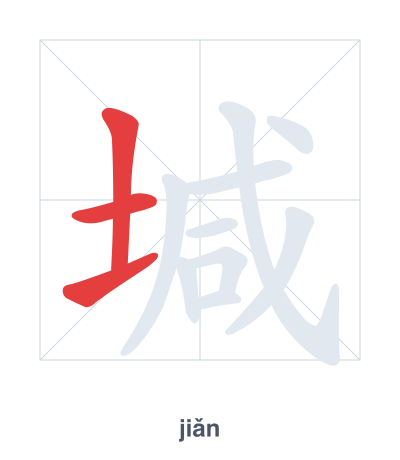
Open Hanzi Writer to see the animated stroke order and practice writing 堿 with real-time feedback.
The character 堿 (jiǎn) is written with 12 strokes. Follow the standard Chinese stroke order: top to bottom, left to right, outside before inside. The radical 土 is one of its key components.
Practice the correct stroke order with the Hanzi Writer app to see animated stroke-by-stroke guidance with real-time feedback.
堿 means alkali / soda.
The character 堿 combines the radical 土 (earth) with 咸 (salty), indicating a salty earth from which alkali is extracted. The component 咸 itself means 'saltiness' and was traditionally used to describe mineral deposits on soil. Together they depict alkaline soil or soda ash found in nature.
💡 Memory Tip: Picture a pile of earth (土) that tastes incredibly salty (咸) because it's actually alkali powder - one lick and you'll pucker!
这种肥皂是堿性的。
zhè zhǒng féi zào shì jiǎn xìng de
This soap is alkaline.
这片土地是盐堿地。
zhè piàn tǔ dì shì yán jiǎn dì
This land is saline-alkali soil.
厨房里有一瓶纯堿。
chú fáng lǐ yǒu yī píng chún jiǎn
There is a bottle of soda ash in the kitchen.
Open Hanzi Writer to see the animated stroke order and practice writing 堿 with real-time feedback.
✨ Animated stroke order · Handwriting recognition · HSK-graded practice · Free to use
堿 is made of the radical 土 (earth) on the left and the phonetic component 咸 (salty) on the right. Together, they suggest "earthy saltiness," which refers to alkali — a substance found in salty soil.