畸 (jī) means "Abnormal / Lopsided / Irregular" in Chinese. It has 13 strokes with the radical 田, and is HSK Level 7.
Rated 4.2/5 in difficulty (advanced).
Harder than 72% of HSK Level 7 characters.
Appears in 3+ common words including 畸形 (jī xíng), 畸零 (jī líng), 畸重 (jī zhòng).
Due to its 13 strokes, Hanzi Writer's error detection shows 畸 requires focused practice — most learners need 10+ attempts for consistent accuracy.
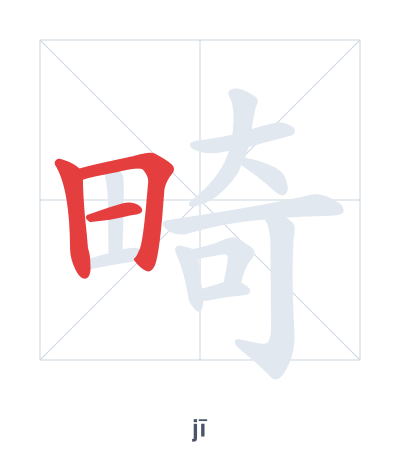
Open Hanzi Writer to see the animated stroke order and practice writing 畸 with real-time feedback.
The character 畸 (jī) is written with 13 strokes. Follow the standard Chinese stroke order: top to bottom, left to right, outside before inside. The radical 田 is one of its key components.
Practice the correct stroke order with the Hanzi Writer app to see animated stroke-by-stroke guidance with real-time feedback.
畸 means Abnormal / Lopsided / Irregular.
As an HSK Level 7 character, 畸 is an intermediate-level character.
畸 combines the radical 田 (field) with 奇 (strange, odd), which also provides the sound. Originally it referred to irregular or uneven fields—i.e., land that is not neatly rectangular—hence the meanings 'abnormal' or 'lopsided.'
💡 Memory Tip: Imagine a field (田) that is so strangely crooked (奇) it looks like a lopsided patchwork of bizarre shapes.
这种发展是畸形的。
zhè zhǒng fā zhǎn shì jī xíng de
This development is abnormal.
剩下的畸零地不多。
shèng xià de jī líng dì bù duō
There isn't much odd-shaped land left.
这里的负担畸重。
zhè lǐ de fù dān jī zhòng
The burden here is excessively heavy.
Open Hanzi Writer to see the animated stroke order and practice writing 畸 with real-time feedback.
✨ Animated stroke order · Handwriting recognition · HSK-graded practice · Free to use
畸 is made of the radical 田 (field) on the left and 奇 (strange/odd) on the right. The combination suggests a field that is irregular or lopsided, which matches the meaning of abnormal or uneven.